《Professional Interpretation and Dietary Applications of Snow Pear》
1. Nature, Taste & Meridians
- Nature & Taste: Sweet, slightly sour, cool
- Meridians: Lung, Stomach, Heart
Professional Interpretation:
- The “sweet” taste nourishes, harmonizes, and soothes, mainly acting on the Lung and Stomach meridians to replenish Yin fluids, relieving thirst and dry cough caused by fluid depletion.
- The “slightly sour” property combines with the sweet taste to generate Yin (“sour + sweet generates Yin”), enhancing the nourishment of body fluids and blood, making the Yin-nourishing effect longer-lasting and gentle.
- The “cool” property gives it heat-clearing and fire-purging effects, especially suitable for alleviating dryness-heat or deficient heat in the Lung and Stomach, with mild and gentle action.
2. Core Theories of Traditional Chinese Medicine (TCM)
In TCM theory, the core value of snow pear lies in “moistening dryness” and “clearing heat.”
- Moistens dryness: Mainly targets the autumn dryness pathogen. When dryness injures the Lung Yin, symptoms like dry cough, scanty phlegm, dry mouth/nose, and itchy skin appear. The abundant juice and sweet-cool nature of snow pear enter the Lung meridian, rapidly replenishing fluids, making it a top dietary choice for warming dryness injuring the Lung.
- Clears heat: Heat-clearing effects occur in 3 aspects:
- Clears Lung heat: Treats cough, yellow phlegm, or sore throat caused by Lung heat or dryness-heat injuring Lung.
- Clears Stomach heat: Relieves thirst, craving cold drinks, dry mouth, and halitosis caused by excessive Stomach fire.
- Clears Heart heat: Assists in calming irritability, insomnia, or mouth ulcers caused by Heart fire disturbance.
- “Lung and Large Intestine are interior-exterior”: Snow pear enters Lung & Large Intestine meridians; its moistening nature nourishes the Lung and, by regulating Lung Qi, also moisturizes the intestines, improving constipation caused by Lung heat affecting the Large Intestine.
3. Evidence from Modern Nutritional Science
Modern nutritional analysis shows that the traditional effects of snow pear align closely with its nutritional components:
Water & dietary fibre: Snow pear is about 85% water and rich in soluble fibre (pectin). These form a protective layer on the digestive and respiratory mucosa, relieving dry cough and intestinal dryness, providing direct support for “nourishing fluids & moistening dryness, moistening intestines & relieving constipation.”
Sorbitol: Snow pear contains natural sorbitol, a highly hydrophilic substance that maintains intestinal moisture, softens stools, and effectively relieves constipation.
Vitamins & antioxidants:
- Vitamin C: A strong antioxidant, helps resist infections, supports immune health, and participates in collagen synthesis, aiding skin elasticity and hydration, supporting the “skin-moistening” and “heat-clearing” effects.
- Phenolic & flavonoid compounds: Important antioxidants, mainly in the peel, help scavenge free radicals, reduce oxidative stress and inflammation, explaining snow pear’s heat-clearing and anti-inflammatory mechanisms from a modern scientific perspective.
4. Summary of Core Effects
- Nourishes fluids & moistens dryness: For thirst, dry mouth, and dry skin due to fluid depletion
- Clears heat & transforms phlegm: For cough with yellow sticky phlegm, sore throat due to Lung heat
- Clears Heart heat & calms irritability: For irritability, insomnia, mouth ulcers caused by Heart fire
- Moistens intestines & relieves constipation: For dry stools due to intestinal dryness & fluid deficiency
5. Traditional Dietary Recipes with Modern Adaption
<Moistening the Bowels & Enhancing Blood Circulation for Beauty >
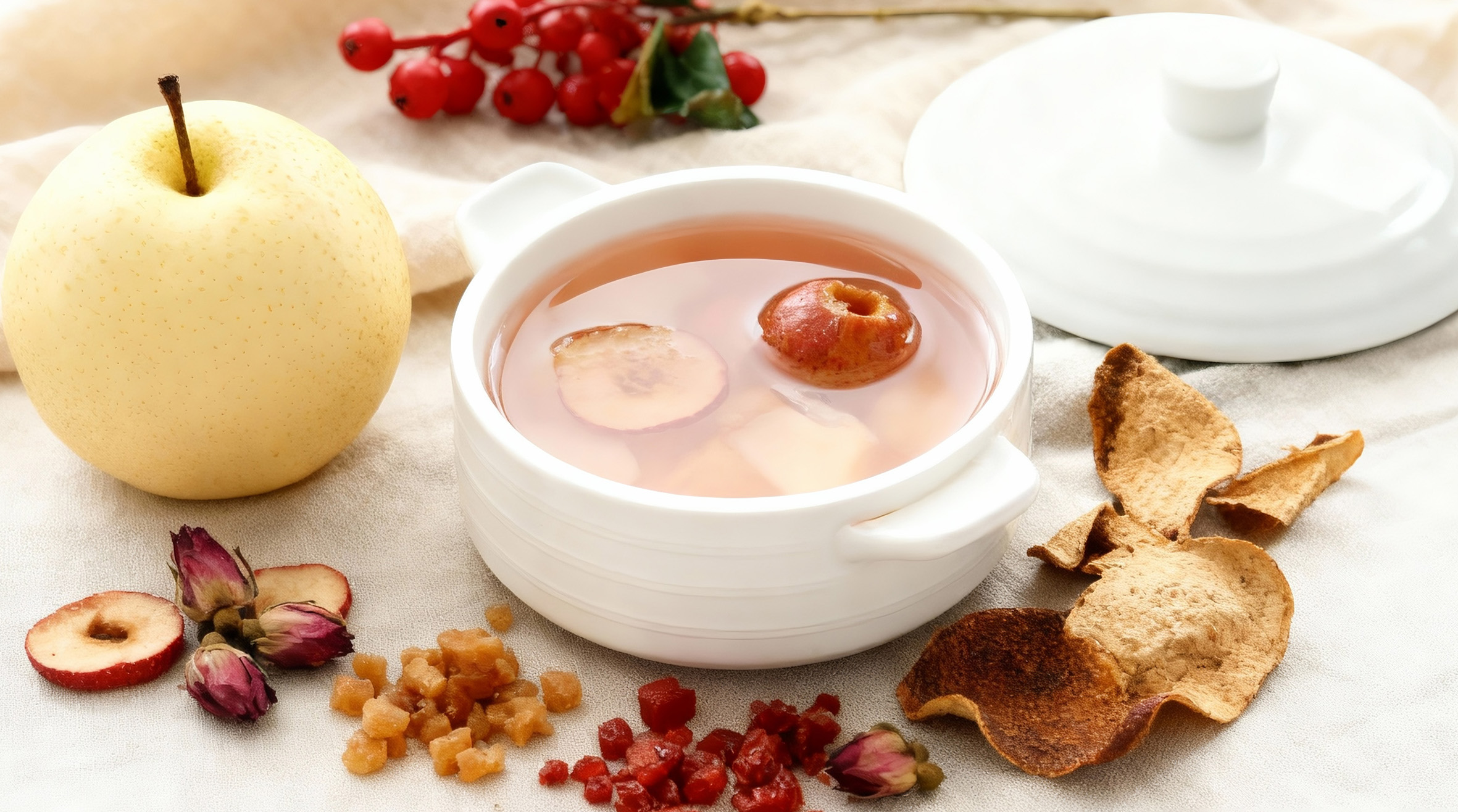
Pear, Rose & Hawthorn Soup
This recipe focuses on “regulating Qi and activating blood circulation,” promoting intestinal movement and improving overall blood flow to achieve bowel lubrication, better skin moisture, and a brighter complexion.
Main Functions: Regulates Qi, relieves stagnation, moistens the bowels, improves complexion.
Best suited for: Constipation, bloating, dull or yellowish facial complexion, high stress levels, and office workers who sit for long hours.
Ingredients:
1. Pear 1 pc
▪ Nature & Meridians: Sweet, slightly sour, cool; enters the Lung and Large Intestine meridians
▪ Functions: Generates fluids, moistens dryness, promotes bowel movement
2. Hawthorn 5 slices
▪ Nature & Meridians: Sour, sweet, slightly warm; enters Spleen, Stomach, Liver meridians
▪ Functions: Aids digestion, reduces food stagnation, invigorates blood, disperses stasis
3. Rose Buds 5 pcs
▪ Nature & Meridians: Sweet, slightly bitter, warm; enters Liver and Spleen meridians
▪ Functions: Moves Qi, relieves emotional stagnation, invigorates blood, alleviates pain
4.Dried Tangerine Peel 1 pc (small)
▪ Nature & Meridians: Pungent, bitter, warm; enters Spleen and Lung meridians
▪ Functions: Regulates Qi, strengthens digestion, dries dampness, resolves phlegm
Preparation (With i-Processor)
- Wash the pear, cut it into chunks with the skin on, remove the core
- Place all ingredients into the iTAZZO i-Processor, set to speed 8, and blend for 10 minutes.
Preparation:
- Wash the pear, cut it into chunks with the skin on, remove the core and cook together with hawthorn slices and dried tangerine peel in water for 20 minutes.
- Turn off the heat, add rose buds while still hot, cover, and let steep for 5–10 minutes to release aroma and nutrients.
- Consume the drink. You may add a small amount of rock sugar or honey if desired.
Consumption Tips & Precautions
Best time:
1 hour after breakfast. Morning Yang energy rises, which supports metabolism and promotes bowel movement for detoxification.
Frequency:
3–4 times per week, after meals.
Important Reminders:
- Use with caution during pregnancy.
- Reduce hawthorn if you have excessive stomach acid.
《雪梨专业解读与⻝疗应⽤》
⼀、 性味归经
- 性味:⽢、微酸,凉
- 归经:肺、胃、⼼经
【专业解读】
- 其“⽢”味能补、能和、能缓,主要作⽤于肺胃⼆经,以补益肺胃之阴津,缓解因津伤导致的⼝渴、⼲咳等急迫症状。
- 其“微酸”之性,能与⽢味化合⽽⽣阴(酸⽢化阴),增强其滋养⼈体津液和⾎液的效⼒,使滋阴效果更为持久绵密。
- “凉”性则赋予其清热、泻⽕之功,尤其善于清解肺与胃中的燥热与虚热,性质温和⽽不峻猛。
⼆、 传统中医理论核⼼
在中医理论中,雪梨的核⼼价值在于 “润燥”与 “清热”。
- 润燥:它主要针对 “秋燥” 这⼀外邪。当燥邪伤肺,导致肺阴亏损,便会出现 ⼲咳少痰、⼝⿐⼲燥、⽪肤⼲痒等症状。雪梨汁液充盈,性味⽢凉,能直⼊肺经,迅速补充被耗伤的津液,是治疗温燥伤肺的⻝疗⾸选。
- 清热:其清热作⽤体现在三个⽅⾯:
- 清肺热:治疗肺热壅盛或燥热伤肺引起的咳嗽、⻩痰、咽喉肿痛。
- 清胃热:缓解胃⽕亢盛导致的⼝渴、喜冷饮、⼝⼲⼝臭。
- 清⼼热:对于⼼⽕内扰所致的烦躁、失眠、⼝⾆⽣疮有辅助清降之效。
- “肺与⼤肠相表⾥”:雪梨归肺与⼤肠经,其润泽之性不仅能润肺,还能通过疏通肺⽓来润泽肠道,对于肺热移于⼤肠所致的肠燥便秘有良好的改善作⽤。
三、现代营养科学佐证
现代营养学分析表明,雪梨的传统功效与其所含的特定营养成分⾼度吻合:
- ⽔分与膳⻝纤维:雪梨约85%为⽔分,并富含可溶性膳⻝纤维(如果胶)。它们能在消化道和呼吸道黏膜形成⼀层润滑的保护膜,起到物理性的 “润燥”作⽤,缓解⼲咳和肠道⼲涩,这为“⽣津润燥、润肠通便”提供了直接依据。
- ⼭梨糖醇:雪梨富含天然的⼭梨糖醇,这是⼀种具有强亲⽔性的物质,能在肠道中维持⽔分,软化⼤便,有效缓解便秘。
- 维⽣素与抗氧化剂:
- 维⽣素C:是强⼤的抗氧化剂,能帮助身体抵抗感染,促进免疫系统健康,并参与胶原蛋⽩的合成,有助于⽪肤保持弹性和⽔润,佐证其“润肤”与“清热”的效果。
- 酚类与⻩酮类化合物:这些是雪梨中重要的抗氧化物质,尤其存在于果⽪中。它们能帮助清除⾃由基,减轻身体的氧化应激和炎症反应,这从现代医学⻆度解释了雪梨“清热”、“抗炎”的机制。
四、核⼼功效总结
- ⽣津润燥:针对津液耗伤之⼝⼲、⼝渴、⽪肤⼲燥。
- 清热化痰:针对肺热燥咳、痰⻩黏稠、咽喉肿痛。
- 清⼼除烦:针对⼼⽕内扰之⼼烦、失眠、⼝⾆⽣疮。
- 润肠通便:针对肠燥津亏之⼤便⼲结。
五、⻝疗古⽅新制
【润肠通便 & 活⾎美颜】
雪梨玫瑰⼭楂饮
此⽅侧重于“理⽓活⾎”,通过促进肠道蠕动和身体⾎液循环来达到通便、润肤、提亮⽓⾊的效果。
核⼼功效:理⽓解郁,润肠通便,改变⽓⾊。
最佳体征:便秘、腹胀,⾯⾊晦暗或带有⻩⽓,情绪压⼒⼤,久坐不动的上班族。
⻝材:
1. 雪梨:1 个
- 性味归经:⽢、微酸,凉;归肺、⼤肠经
- 功效:⽣津润燥,润肠通便
2. ⼭楂:5 ⽚
- 性味归经:酸、⽢,微温;归脾、胃、肝经
- 功效:消⻝化积,活⾎散瘀
3. 玫瑰花:5 朵
- 性味归经:⽢、微苦,温;归肝、脾经
- 功效:⾏⽓解郁,活⾎⽌痛
4. 陈⽪:1 ⼩块
- 性味归经:⾟、苦,温;归脾、肺经
- 功效:理⽓健脾,燥湿化痰
做法(使用i-Processor智能养生机):
- 雪梨洗净带⽪切块,祛核,以及⼭楂也要洗净
- 将所有材料放入 i-Processor 智能养生机,档速8搅拌10分钟即可。
做法:
- 雪梨洗净带⽪切块,祛核与洗净的⼭楂、陈⽪⼀同放⼊锅中,加⽔煮20分钟。
- 关⽕后,趁热放⼊玫瑰花,盖上盖⼦焖泡5-10分钟,利⽤余温释放其⾹⽓和营养。
- 可滤出汤⽔饮⽤,亦可酌加少量冰糖或蜂蜜调味。
饮⽤宜忌与温馨提示
- ⻩⾦饮⽤时间:早餐后1⼩时。早晨阳⽓升发,最利⽔湿代谢,此时饮⽤能有效推动肠道蠕动,助⼒排毒。
- 饮⽤频率:可每周饮⽤3-4次,餐后饮⽤。
- 核⼼提醒:
- 孕妇慎⽤。
- 胃酸过多者可减少⼭楂⽤量。