《 Professional Interpretation & Dietary Applications of Carrots 》
1. Nature, Taste and Meridian
Nature and Taste: Sweet, Pungent, Neutral
Meridian Entered: Spleen, Liver, Lung meridians
Professional Interpretation
The sweet taste has tonifying, harmonizing, and moderating properties in TCM, helping to replenish Middle Qi and nourish the Spleen and Stomach. The pungent taste has dispersing and moving properties, helping support the diffusion of Lung Qi and the smooth flow of Liver Qi. The natural sweetness of carrots comes from their naturally occurring sugars and carotenoids, which provide a gentle source of nourishment for the Middle Jiao. Their pungent property is traditionally associated with aromatic and volatile components that help awaken the Spleen, support appetite, and promote the movement of Qi to relieve stagnation.
Their neutral nature means that carrots are neither excessively cooling nor warming, making them suitable for regular consumption by most body constitutions, especially for children, elderly, and individuals recovering from illness or weakness.
Carrots have a reddish-yellow colour, traditionally interpreted through the relationship between the Wood, Fire, and Earth elements. Their reddish-yellow colour is associated with the Spleen and Stomach and is traditionally regarded as supporting Qi. Their shape resembles the eyes, while their colour is associated with the Liver, further linking them to the traditional TCM function of nourishing the Liver and supporting vision.
Carrots are sometimes referred to in folk tradition as “little ginseng” because of their traditional functions of strengthening the Spleen and harmonizing the Middle, while nourishing the Liver and supporting vision. They have traditionally been used in dietary therapy for childhood malnutrition associated with food stagnation, as well as symptoms such as poor night vision.
As recorded in the Compendium of Materia Medica (Ben Cao Gang Mu), carrots are traditionally described as helping to direct Qi downward, tonify the Middle, support the chest and digestive system, harmonize the 5 internal organs, and improve appetite. For this reason, they are regarded as a valuable food within the TCM tradition of medicine and food sharing the same source.
2. Core Concepts in Traditional Chinese Medicine (TCM)
In TCM health preservation, the core value of carrots lies in “Strengthening the Spleen and Harmonizing the Middle,” “Nourishing the Liver and Supporting Vision,” and “Clearing Heat and Detoxifying.”
Strengthens the Spleen and Harmonizes the Middle:
TCM regards the Spleen and Stomach as the foundation of postnatal life and the source of Qi and Blood production. Carrots are yellow in colour and sweet in taste, and are traditionally associated with the Spleen and Stomach meridians, helping to support Spleen and Stomach Qi.
The Spleen governs transformation and transportation, while the Stomach governs the receiving of food. When the Spleen and Stomach function well, food and fluids can be properly digested and transformed, providing a sufficient source for the production of Qi and Blood.
Carrots are neutral in nature and are not excessively drying. They provide gentle dietary support for patterns of Middle Qi deficiency associated with Spleen and Stomach weakness, such as poor appetite, indigestion, fatigue, weakness, and abdominal fullness or bloating. In TCM terms, they act like a gentle source of support for a weakened Spleen and Stomach, helping restore their normal functions of transformation and transportation.
Nourishes the Liver and Supports Vision:
Carrots have a reddish colour and are traditionally associated with the Liver meridian. The Liver opens into the eyes, and sufficient Liver Blood is considered essential for nourishing vision.
The nutrients found in carrots help nourish the body and support eye health from a modern nutritional perspective. In traditional dietary therapy, carrots are used to support symptoms associated with Liver Blood deficiency or Liver Yin deficiency, such as blurred vision, dry or irritated eyes, and poor night vision.
They are also traditionally used in dietary therapy for childhood malnutrition associated with improper feeding, Spleen weakness and Liver hyperactivity, particularly when accompanied by dry eyes and sensitivity to light.
Their functions of strengthening the Spleen and nourishing the Liver work together: when the Spleen is strong, Qi and Blood have an adequate source of production; when the Liver is sufficiently nourished, the eyes are better supported.
Clears Heat and Detoxifies:
Carrots are neutral and moistening in nature, and are traditionally used to help clear accumulated heat from the Lung and Stomach systems.
For symptoms associated with heat accumulation, such as a sore or swollen throat, mouth or tongue sores, lingering heat following a febrile illness, irritability, thirst, and dry mouth, carrots are traditionally believed to help direct Qi downward and ease the Middle, allowing heat to be dispersed through urination and bowel movements while supporting the production of body fluids and relieving thirst.
Their dietary fibre also supports bowel regularity. By keeping the Large Intestine unobstructed provides a pathway for accumulated heat to be eliminated. For this reason, carrots may also be used as supportive dietary therapy for patterns involving intestinal dryness and constipation, as well as discomfort associated with swollen or painful haemorrhoids.
3. Supporting Evidence from Modern Nutritional Science
Modern nutritional analysis suggests that many of the traditional uses of carrots may be associated with their distinctive nutritional and bioactive compounds:
Beta-Carotene:
Carrots are one of the richest natural dietary sources of beta-carotene. In the body, beta-carotene can be converted into vitamin A, which is essential for normal retinal function, particularly vision in low-light conditions. This provides a modern nutritional perspective on the traditional TCM concept of “Nourishing the Liver and Supporting Vision,” especially in relation to poor night vision. Vitamin A also helps maintain the integrity of epithelial tissues and mucous membranes, including those of the respiratory and digestive tracts and the skin, thereby supporting the body’s natural barrier functions. This may help explain, from a nutritional perspective, the traditional use of carrots in supporting mucosal health and the body’s resistance to external pathogenic factors.
Alpha-Carotene:
Carrots contain higher alpha-carotene, an antioxidant carotenoid that helps protect cells against oxidative stress and free-radical damage. It has been studied for its role in supporting long-term cellular health, as well as cardiovascular and eye health.
Vitamin C and B Vitamins:
Carrots provide vitamin C (approximately 5–13 mg per 100 gm) as well as several B vitamins (especially vitamins B1, B2, and B6). Vitamin C supports collagen formation, helps maintain the structural integrity of blood vessels, and enhances the absorption of non-haem iron. B vitamins function as important coenzymes in energy metabolism and nervous system activity. They also contribute to digestive function and the secretion of digestive juices. From a nutritional perspective, these functions broadly correspond with the traditional TCM concept of Strengthening the Spleen and Harmonizing the Middle to support appetite and vitality.
Dietary Fibre (Pectin):
Carrots contain soluble dietary fibre, including pectin, which absorbs water and helps soften stools while supporting normal intestinal movement. Dietary fibre also contributes to healthy bowel function and the elimination of metabolic waste through the digestive tract. Pectin can form a gel-like substance in the intestine, which supports a more gradual post-meal rise in blood glucose.
Volatile Compounds and Lignin:
Carrots contain naturally occurring aromatic volatile compounds, including substances such as alpha-pinene and limonene. These compounds contribute to their characteristic aroma and may help stimulate appetite and digestive secretions, which is broadly consistent with the traditional TCM function of Strengthening the Spleen and Supporting Appetite. Carrots also contain plant structural compounds such as lignin and other phytochemicals that have been studied for antioxidant and immune-related activities. These compounds may contribute to the overall protective effects of a nutrient-rich diet, including support for respiratory and immune health.
Additional Key Point:
A Gentle Food for Supporting the 5 Internal Organs and Eye Health
Carrots combine several nutritional features that broadly correspond with their traditional dietary uses: supporting digestive function through dietary fibre and aromatic compounds, supporting vision and eye health through beta-carotene, and providing antioxidant and mucosal support through vitamin C and other phytochemicals.
From a TCM dietary therapy perspective, carrots are a gentle everyday food suitable for supporting children with poor appetite or nutritional weakness, individuals experiencing eye fatigue, those seeking to support respiratory mucosal health, and people recovering after febrile illness.
Their neutral nature makes them relatively balanced and suitable for regular dietary use. With consistent and appropriate consumption, they are traditionally valued for gently supporting Spleen and Stomach function, vitality, and the nourishment of the Liver and eyes.
4. Summary of Core Effects
Strengthens the Spleen and Harmonizes the Middle:
Suitable for Spleen and Stomach Qi deficiency patterns associated with poor appetite, abdominal bloating after meals, indigestion, fatigue, weakness, and irregular bowel movements.
Nourishes the Liver and Supports Vision:
Suitable for symptoms associated with Liver Blood deficiency, such as blurred vision, dry or irritated eyes, poor night vision, and childhood malnutrition affecting the eyes.
Clears Heat and Detoxifies:
Suitable for Lung and Stomach heat patterns associated with a sore or swollen throat, mouth or tongue sores, irritability, thirst, dry mouth, early-stage swollen sores or skin lesions, and constipation due to intestinal dryness.
Directs Qi Downward and Relieves Fullness in the Middle:
Suitable for chest or upper abdominal fullness, belching, nausea, and mild cough with excessive phlegm associated with impaired descent of Lung Qi.
5. Traditional Dietary Recipe with Modern Adaptation
Indications: Respiratory concerns, including cough with excessive phlegm, itchy throat, chest tightness, and spasmodic coughing associated with whooping cough
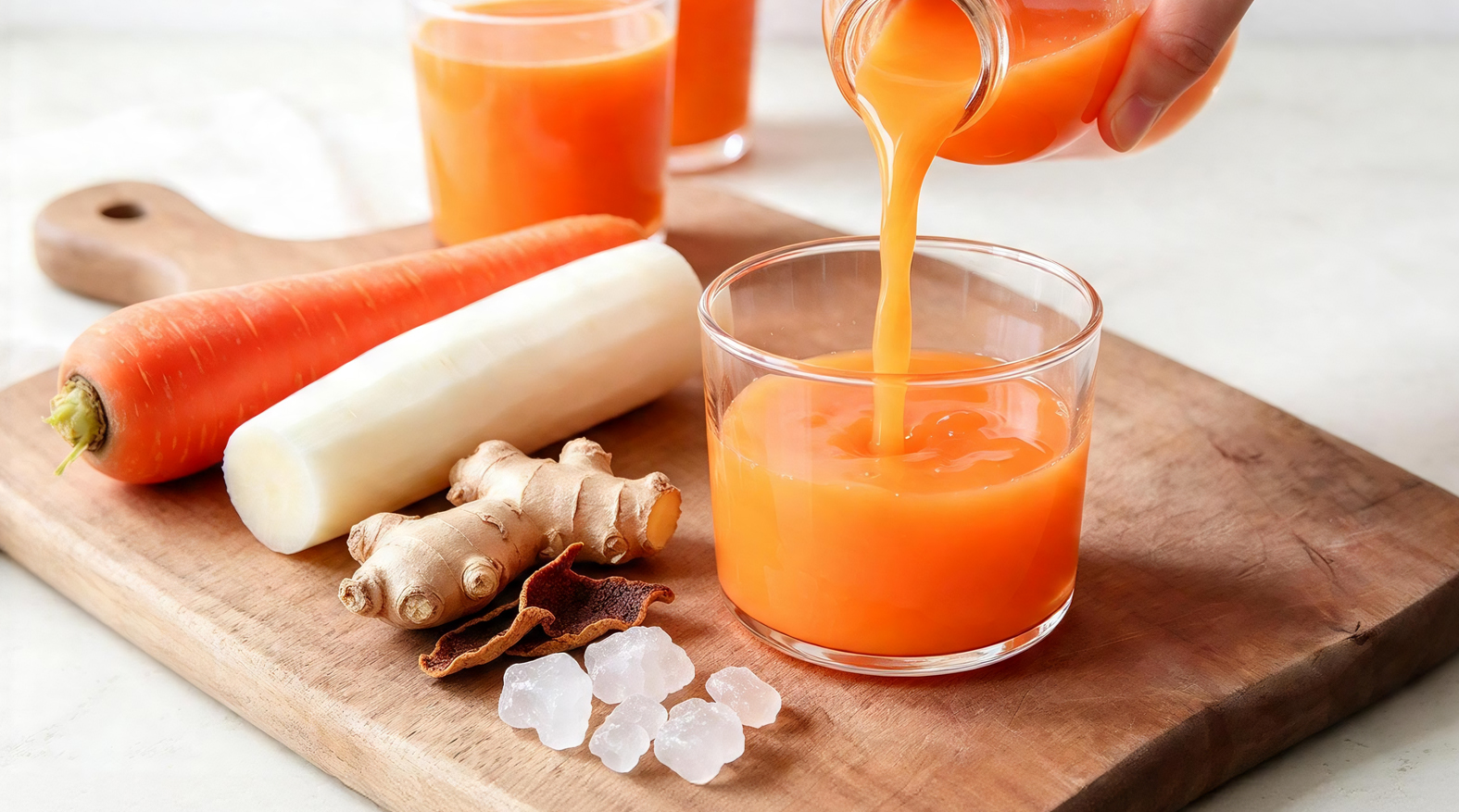
Carrot Lung-Dispersing & Phlegm-Resolving Drink
Best Suited For:
Impaired diffusion of Lung Qi with phlegm obstructing the Lungs — recurrent cough, excessive white or slightly yellow phlegm that is difficult to expectorate, and coughing triggered by an itchy throat; chest tightness, shortness of breath, or audible phlegm in the throat; paroxysmal spasmodic coughing associated with childhood whooping cough, with facial flushing or retching during coughing episodes; accompanied by poor appetite, reduced food intake, or irregular bowel movements; pale-red tongue with a thin white or slightly greasy coating.
Ingredients (1–2 servings):
Carrot – 100 gm
Nature & Meridian: Sweet, pungent, neutral; enters Spleen, Liver, Lung meridians
Benefits: Strengthens the Spleen and harmonizes the Middle, directs Qi downward and resolves phlegm, disperses Lung Qi, and relieves cough. It serves as the core ingredient for supporting both the Lung and Spleen according to the TCM principle of “strengthening Earth to support Metal.”
White Radish – 60 gm
Nature & Meridian: Pungent, sweet, cooling; enters Lung, Stomach meridians
Benefits: Clears heat and resolves phlegm, directs Qi downward and relieves fullness in the Middle, supports digestion, and reduces bloating. It is traditionally used to clear phlegm from the Lungs. Specifically resolves phlegm and turbidity in the Lungs. Together with carrot, the two ingredients balance warmth and coolness, harmonising cold and heat.
Aged Tangerine Peel – 2 gm
Nature & Meridian: Pungent, bitter, warm; enters Spleen, Lung meridians
Benefits: Regulates Qi, strengthens the Spleen, dries dampness, and resolves phlegm. Keeping Qi moving smoothly while preventing stagnation and supports the clearing of phlegm without allowing dampness to accumulate.
Fresh Ginger – 2 slices
Nature & Meridian: Pungent, slightly warm; enters Lung, Spleen, Stomach meridians
Benefits: Warms the Middle and dispels cold, releases the exterior and promotes sweating, and warms the Lungs to relieve cough. Using ginger with the peel retained helps moderate its drying nature while dispersing cold from the Lung system.
Rock Sugar – 5 gm
Nature & Meridian: Sweet, neutral; enters Lung, Spleen meridians
Benefits: Tonifies the Middle and replenishes Qi, harmonizes the Stomach, moistens the Lungs, relieves thirst, and resolves phlegm. It harmonizes the flavours of the formula and moderates the cooling nature of white radish.
Hot Water – 450 ml
Preparation:
- Wash the carrot and cut it into small pieces. Wash and slice the white radish. Rinse the aged tangerine peel and wash and slice the fresh ginger.
- Place all ingredients into the iTAZZO i-Processor and blend at Speed 8 until fine and smooth, approximately 5 minutes. Serve warm.
Consumption Tips and Precautions
Best Time:
Drink one warm serving of approximately 250 ml each morning on an empty stomach, preferably between 5–7 AM, when Lung meridian is active. Consume when Lung meridian is active helps support the Lung’s functions of diffusion and descent and clearing phlegm.
If coughing is more pronounced at night, an additional serving may be taken before bedtime, between 9–11 PM.
Frequency and Duration:
Acute phase: During cough or wheezing, consume twice daily for 5–7 consecutive days, or until phlegm sounds and coughing frequency have reduced.
Recovery and ongoing care (lingering cough after illness or constitutional weakness with frequent respiratory discomfort): Consume once each morning, 5 times per week, for 14 days as one course.
Important Reminder:
【Recommended】 Persistent cough following a wind-cold common cold (with thin, white sputum and an itchy throat); the spasmodic coughing phase of whooping cough in children (more effective when combined with honey); and chronic bronchitis associated with phlegm-dampness obstructing the Lungs.
Important Precautions:
【Combinations to Avoid】 Avoid consuming large amounts of cooling, Lung-moistening remedies such as Chuan Bei and loquat syrup together with this drink, as combining opposing thermal properties may create an imbalance and trap pathogens internally. Avoid consuming it with greasy or rich foods, as these may promote dampness and phlegm.
- 【Expected Response】 Within approximately 30 minutes of drinking, the throat may feel clearer, phlegm may become thinner and easier to expectorate, and chest tightness may ease. If coughing temporarily increases after drinking, this may indicate that phlegm is being expelled. Continue drinking for another 1–2 days; coughing and phlegm should then decrease, leading to recovery.
《 红萝卜的专业解读与食疗应用 》
一、性味归经
性味:甘、辛,平 归经:脾、肝、肺经
【专业解读】
其“甘”味能补、能和、能缓,具有补益中气、滋养脾胃的作用;“辛”味则能行、能散,有助于宣发肺气、疏达肝气。红萝卜之甘,源于其丰富的天然糖分和红萝卜素,能温和地补充中焦能量;其辛,则来自其独特的挥发油成分,能醒脾开胃,行气导滞。
其性“平”,不寒不热,性质温和,适宜大多数体质长期食用,尤宜于小儿、老人及病后体虚之人。
红萝卜色赤黄,得木火土相生之气——赤黄入脾胃以益气,其形似眼、色如肝,更入肝经以明目。民间称其为“小人参”,正因其健脾和中、滋肝明目之功,尤善调治小儿疳积(食积)与夜盲诸症。正如《本草纲目》所载,红萝卜“下气补中,利胸膈肠胃,安五脏,令人健食”,是药食同源之佳品。
二、传统中医理论核心
在中医养生理论中,红萝卜的核心价值在于 “健脾和中”、“滋肝明目” 与 “清热解毒”。
健脾和中:中医认为“脾胃为后天之本,气血生化之源”。红萝卜色黄味甘,入脾、胃二经,最能补益脾胃之气。脾主运化,胃主受纳,脾胃功能健旺,则饮食水谷得以正常消化吸收,气血化生有 源。红萝卜性平不燥,对于因脾胃虚弱导致的食欲不振、消化不良、体倦乏力、脘腹胀满等“中气不足”之证,有平和的调养作用。它如同给疲弱的脾胃输送温和的动力,使其恢复正常的运化转输功 能。
滋肝明目:红萝卜色赤,入肝经,肝开窍于目,肝血充足则目得所养。其富含之营养能直接濡养眼部脉络,对肝血不足、肝阴亏虚所致的视物昏花、眼干眼涩、夜盲症(雀目)有极佳的食疗调养作用。尤其是小儿因喂养不当、脾虚肝旺所致的疳积上眼、双目干涩羞明,红萝卜更是不可或缺的调理食材。其“健脾”与“养肝”相辅相成——脾土健旺则气血有源,肝木得养则目窍精明。
清热解毒:红萝卜性平而质润,能清解肺胃之热毒。对于热毒蕴结所致的咽喉肿痛、口舌生疮,或温热病后余热未清、烦渴口干,红萝卜能通过其“下气宽中”之力,使热邪从二便分消,从而起到清解热毒、生津止渴的作用。同时,其富含的膳食纤维能通利大肠,使热毒有出路,故对肠燥便秘、痔疮肿痛等亦有辅助调理之效。
三、现代营养科学佐证
现代营养学分析表明,红萝卜的传统功效与其独特的化学成分密不可分:
- β-红萝卜素:红萝卜是 β-红萝卜素含量最丰富的天然来源之一。β-红萝卜素在人体内可转化为维生素 A,是维持视网膜感光功能(尤其暗光视觉)的核心物质,直接支持了中医“滋肝明目”治疗夜盲症的功效。同时,维生素 A 能维护上皮组织黏膜(如呼吸道、消化道、皮肤)的完整性,增强屏障防御功能,这与“清热解毒”中保护黏膜、抵御外邪的作用相吻合。
- α-红萝卜素:红萝卜中含有较高的 α-红萝卜素,这是一种强效的类红萝卜素抗氧化剂,其清除自由基、保护细胞 DNA 的能力甚至优于 β-红萝卜素。它能有效降低氧化应激损伤,延缓细胞衰老,对心血管和眼睛的长期健康有益。
- 维生素 C 与 B 族维生素:红萝卜富含维生素 C(每 100g 约含 5-13mg)及 B 族维生素(尤其是 B1、B2、B6)。维生素 C 促进胶原蛋白合成,维护血管壁弹性,辅助铁吸收;B 族维生素作为辅酶,参与能量代谢和神经信号传导,能有效缓解疲劳,改善消化液分泌,从营养学角度印证了“健脾和中”改善食欲、恢复体力的作用。
- 膳食纤维(果胶):红萝卜中富含可溶性膳食纤维果胶,能吸收水分软化粪便,温和促进肠道蠕动,同时吸附肠道中的毒素和代谢废物,促进其排出,起到“清热解毒”中清肠排毒的作用。果胶还能在肠道内形成凝胶,延缓糖分吸收,有助于稳定餐后血糖。
- 挥发油与木质素:红萝卜所含的挥发油(如 α-蒎烯、柠檬烯等)具有芳香开胃、行气导滞的作用,能温和刺激消化液分泌,增进食欲,与中医“健脾开胃”功效直接对应。木质素则是一种植物化学物,具有抗炎、抗病毒和增强免疫活性的作用,有助于机体抵御呼吸道感染。
【补充关键点】温和的“五脏调理剂”与“眼部营养库”:
红萝卜兼具健脾助运(膳食纤维+挥发油)、滋肝明目(β-红萝卜素)、清解热毒(维生素 C+果胶)三大核心功能,是一种理想的小儿疳积调理、眼疲劳恢复、呼吸道黏膜保护及热病后康复的日常食材。其性平不偏,缓缓濡养,持之以恒则脾胃健运而食进神充,肝血得养而目清神爽。
四、核心功效总结
- 健脾和中:针对食欲不振、食后腹胀、消化不良、体倦乏力、大便不调等脾胃气虚证。
- 滋肝明目:针对肝血不足所致的视物昏花、眼干眼涩、夜盲症(雀目)、小儿疳积上眼。
- 清解热毒:针对肺胃热毒所致的咽喉肿痛、口舌生疮、烦渴口干、痈肿疮毒(初起)、肠燥便秘。
- 下气宽中:针对胸膈满闷、嗳气呕恶、咳嗽痰多(肺气不降之轻证)。
五、食疗古方新制
主治:呼吸系统(咳嗽痰多,咽痒胸闷,百日咳痉咳)
最佳体征:肺气不宣、痰浊阻肺——咳嗽反复、痰多色白或微黄、咯吐不爽、咽痒即咳;胸闷气促、喉中痰鸣;小儿百日咳之阵发性痉咳(咳而面赤、呕逆);伴纳呆食少、大便不调;舌质淡红、苔薄白或微腻。
食材(1-2 人份):
红萝卜:100 gm
性味归经:甘、辛,平;归脾、肝、肺经。
功效:健脾和中,下气化痰,宣肺止咳。为全方补土生金、调理肺脾之核心。
白萝卜: 60 gm
性味归经:辛、甘,凉;归肺、胃经。
功效:清热化痰,下气宽中,消食除胀。专化肺中之痰浊,与红萝卜一温一凉,平调寒热。
陈皮:2 gm
性味归经:辛、苦,温;归脾、肺经。
功效:理气健脾,燥湿化痰。使全方行气而不滞,化痰而不留邪。
生姜:2 片
性味归经:辛,微温;归肺、脾、胃经。
功效:温中散寒,解表发汗,温肺止咳。带皮使用,防过燥伤阴,尤善驱散肺中寒邪。
冰糖:5 gm
性味归经:甘,平;归肺、脾经。
功效:补中益气,和胃润肺,止渴化痰。调和诸味,缓白萝卜之凉性。
热水:450 ml
做法:
- 红萝卜洗净,切小块。白萝卜洗净切片。陈皮洗净,生姜洗净切片。
- 将所有食材放入iTAZZO 智能养生机,设定档速 8 号高速搅打至细腻顺滑(约 5 分钟),即可饮用。
饮用宜忌与温馨提示
- 黄金饮用时间:每日晨起(卯时,5-7 点,肺经气血流注最旺时)空腹温饮一杯(约 250 ml)。肺经当令时药食之气直入肺经,宣发肃降之力最强,最宜化痰排浊。若咳嗽夜重者,可于睡前(亥时,9-11 点)加饮一次。
- 饮用频率与疗程:急性咳喘期:每日 2 次,连用 5-7 天,直至痰鸣减轻、咳频下降。慢性调理期(病后余咳、体虚易感):每日早晨一次,每周 5 次,以 14 天为一疗程。
- 核心提醒:【特别推荐】风寒感冒后迁延不愈之咳嗽(痰白清稀、咽痒)、小儿百日咳痉咳期(配蜂蜜效果更佳)、慢性支气管炎属痰湿壅肺者。
- 重要注意事项:【禁忌搭配】忌与川贝、枇杷膏等寒凉润肺之品大量同用,以免寒热混杂,闭痰液变稀易于咯出,胸闷感减轻。若饮后现短暂咳频反增,为排痰之佳兆,继续饮用 1-2日后咳痰减少即愈。