

《 Professional Interpretation & Dietary Applications of Lily Bulb 》
1. Nature, Taste, and Meridians
- Nature & Taste: Sweet, slightly cold
- Meridians Entered: Heart and Lung
Professional Interpretation
- Its sweet flavour is tonifying, moistening and harmonising—providing nourishment and relieving dryness. The sweetness of lily bulb primarily enters the Heart and Lung meridians, where it nourishes Yin fluids, clears deficiency heat, and moistens without cloying. It clears without damaging the upright Qi, making it an excellent substance for “clearing and moistening the Upper Burner”.
- Its slightly cold nature is its key characteristic, being clear, moistening and gently cooling. This enables it not only to nourish Yin and moisten dryness, but also to clear the Heart and calm the spirit. It is especially suitable for Yin deficiency with heat, or for residual heat following febrile disease.
As recorded in Compendium of Materia Medica:
“Lily bulb is sweet and slightly cold in nature. It tonifies the Middle Burner and benefits Qi, moistens the Lung and relieves cough, calms the Heart and the spirit. It is both medicinal and edible in excellence.” Its clear and moistening quality is particularly effective in balancing and protecting fluid in warm-dry conditions or with rich tonifying formulae.
2. CoreConcepts inTraditional Chinese Medicine (TCM)
In Traditional Chinese Medicine, the core value of lily bulb lies in “clearing the Heart and moistening the Lung” and “calming the spirit while stabilizing the corporeal soul.”
- Clearing the Heart and Moistening the Lung:The Lung is a delicate organ that prefers moisture and dislikes dryness; the Heart is the sovereign organ, housing the spirit. Lily bulb, being white in colour, enters the Lung, with a sweet flavour entering the Spleen and a moist, slightly cold nature entering the Heart. Its nourishing power primarily acts on the Lung and Heart. It can nourish Lung Yin, clears Lung heat, and stop cough, making it essential for treating Yin-deficiency dryness with cough or chronic cough with blood-streaked sputum. At the same time, it clears Heart heat, relieves irritability, and calms the spirit. It is particularly effective for restlessness, insomnia, and vivid dreams caused by deficiency heat disturbing the Heart.
- Calming the Spirit and Stabilizing the Corporeal Soul:
- Moistens the Lung and Stops Cough: Lily bulb directly nourishes Lung Yin and clears deficiency fire. It is effective for autumnal dryness-induced cough, tubercular cough, or chronic bronchitis with dry, non-productive cough, providing moistening and cough-relieving benefits.
- Clears the Heart and Calms the Spirit: Its slightly cold nature clears Heart Yin deficiency heat, while its sweet, moist quality nourishes Heart Yin. It can help with post-febrile residual heat causing mental confusion, low mood (as described in TCM as “Bai He disease”), as well as modern conditions such as anxiety, insomnia, and menopausal syndrome.
- Nourishes the Stomach and Generates Fluids: By moistening the Lung, it supports the mutual relationship between Metal (Lung) and Water (Kidney), indirectly helping to nourish Stomach Yin. It may assist in relieving symptoms such as dry mouth, red tongue with scanty fluids, and thirst due to Stomach Yin deficiency.
“Heart and Lung Reside Together in the Upper Burner”: Lily bulb’s cooling and moistening action focuses on the Upper Burner. It addresses both the branch (symptoms) and the root causes (underlying deficiency). For conditions caused by Yin-deficient Lung dryness or floating Heart fire, lily bulb simultaneously nourishes Lung Yin and calms the Heart, achieving balance and stability in the Upper Burner’s Qi and Yin.
3. Supporting Evidence from Modern Nutritional Science
Modern nutritional analysis indicates that the traditional functions of lily bulb are closely associated with its unique nutritional components:
- Lily Polysaccharides and Saponins: Lily bulb is rich in bioactive polysaccharides (such as lily polysaccharides) and steroidal saponins (such as lily saponins). Studies shows that lily polysaccharides exhibit significant antioxidants, anti-fatigue, and immune-regulating activities, help neutralizing free radicals and enhancing body’s resistance. This provides a scientific basis for the TCM concepts of “tonifying deficiency” and “benefiting Qi.” Saponins have been shown to possess antitussive (cough-suppressing), expectorant (phlegm-resolving), and mild sedative effects. These physiological actions directly correspond to the traditional functions of “moistening the Lung to stop cough” and “clearing the Heart to calm the spirit.”
- Colchicine: The lily bulb contains trace amounts of colchicine, which has anti-inflammatory properties and can inhibit the release of inflammatory mediators. This partially explains lily bulb’s traditional use in relieving heat or dryness patterns, which can be understood as a micro-inflammatory state.It should be noted that edible lily bulb contains only minute amounts, making it generally safe; medicinal doses should follow professional guidance.
- Alkaloids and Phenolic Compounds: Lily bulb contains various alkaloids and phenolic antioxidant compounds. These substances may exert regulatory effects on the central nervous system, helping to ease emotional tension and improve sleep quality. From a neurochemical standpoint, this supports its traditional role in calming the spirit and stabilizing mental activity.
- Starch, Protein, and Trace Minerals: Lily bulb provides high-quality starch, small amounts of protein, and essential trace elements such as phosphorus, potassium, magnesium, iron, and zinc. Its fine starch is easily digested, providing stable energy. Trace minerals participate in enzymatic reactions and neurotransmitter synthesis, supporting nervous system stability and immune function.
- 【Key Additional Point】Low Fat and High Potassium Content: Lily bulb is very low in fat and is a good source of potassium, which supports fluid balance and helps maintain stable blood pressure. Its overall nutritional profile—low-calorie, high in water content, and rich in bioactive compounds—aligns well with the TCM characteristics of being “clearing and moistening” and “light tonification.”, making it an ideal food for individuals with Yin deficiency with heat or those requiring gentle, supportive nourishment.
4. Summary of Core Effects
- Nourishes Yin and Moistens the Lung: Addresses Yin-deficiency dryness with cough, chronic cough with blood-streaked sputum, and dry or sore throat.
- Clears the Heart and Calms the Spirit: Addresses vexation, palpitations due to deficiency, insomnia with restless dreams, and mental confusion.
- Nourishes the Stomach and Generates Fluids: Addresses dry mouth and red tongue with scanty fluids caused by Stomach Yin deficiency.
- Beautifies and Moistens the Skin: As the Lung governs the skin and body hair, nourishing Lung Yin helps improve dryness and maintain healthy skin.
5. TraditionalDietary Recipes with Modern Adaptation
【Clears Heat & Relieves Summer Heat】
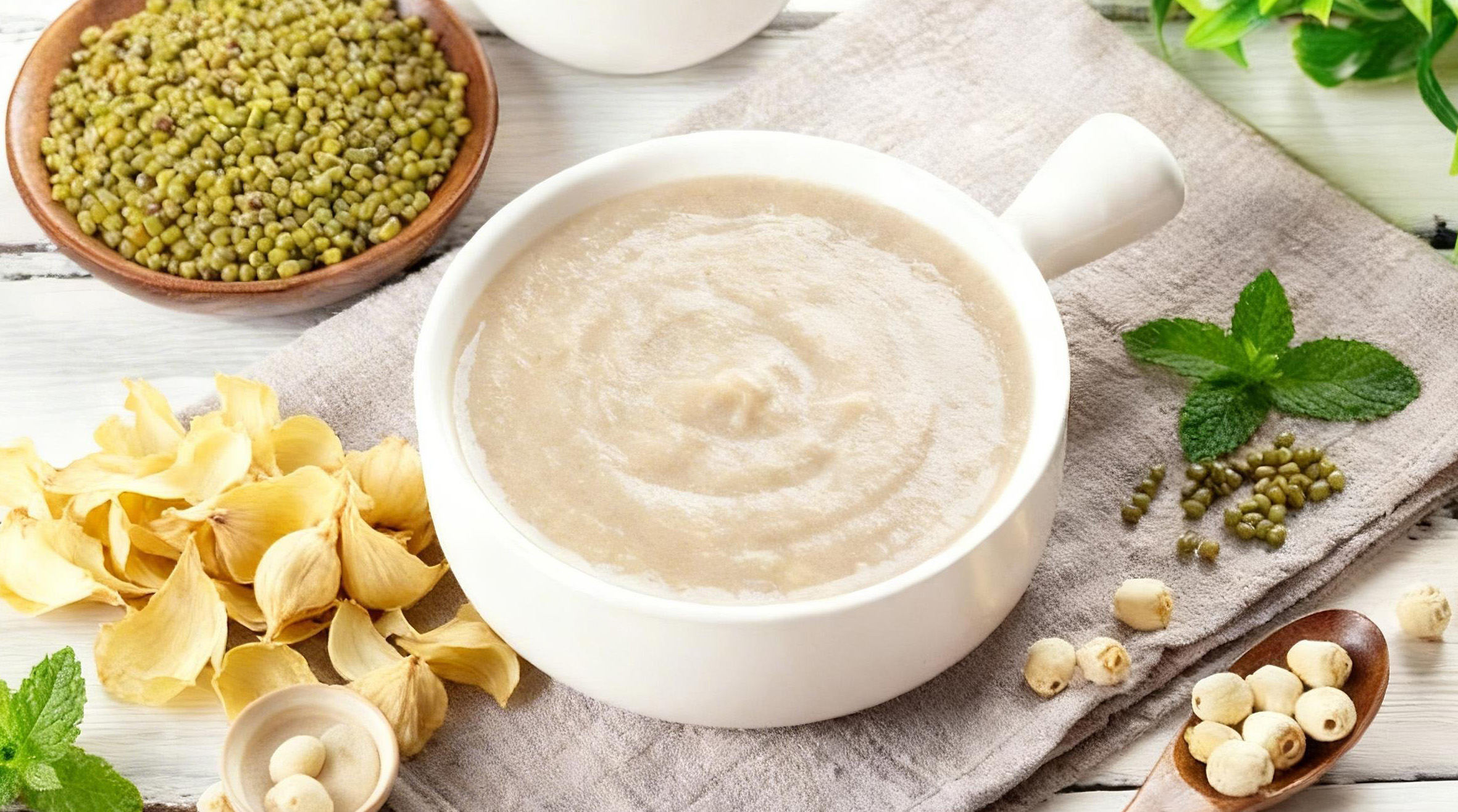
Lily, Mung Bean & Barley Cooling Paste
This formula is especially suitable for the year-round summer climate of Malaysia. When internal damp-heat is present, this “clearing” remedy, combining lily bulb to moisten the lung, Mung Bean to clear Heat, and Barley to drain dampness, helps rapidly relieve summer heat, generate fluids to quench thirst, and prevent heat from damaging body fluids.
Core Effects
Clears heat and detoxifies, relieves summer heat, drains dampness, generates fluids, and reduces irritability.
Best Suited
- Thirst and irritability during hot weather
- Scanty, dark-coloured urine
- Prone to prickly heat or small skin eruptions
- Bitter taste in the mouth or sticky sensation due to internal damp-heat accumulation
Ingredients (1-2 servings)
- Lily Bulb (Fresh preferred): 30 gm (or dried 15 g)
- Nature & Meridians: Sweet, slightly cold; enters the Heart and Lung meridians
- Benefits: Nourishes Yin, moistens the Lung, clears the Heart, calms the spirit
- Mung Bean: 20 gm
- Nature & Meridians: Sweet, cold; enters the Heart and Stomach meridians
- Benefits: Clears heat and detoxifies, relieves summer heat, promotes urination
- Barley: 15 gm
- Nature & Meridians: Sweet, bland, cool; enters the Spleen, Stomach, and Lung meridians
- Benefits: Promotes urination and drains dampness, strengthens the Spleen, stops diarrhea, clears heat, and resolves pus
- Fresh Mint Leaves: 3–4 leaves (or dried mint 2 gm)
- Nature & Meridians: Pungent, cool; enters the Lung and Liver meridians
- Benefits: Disperses wind-heat, clears the head and eyes, benefits the throat, relieving skin eruptions, adds refreshing flavour.
- Filtered Water: 450 ml
Preparation
- Rinse mung beans and barley thoroughly.
- Place all the ingredients into the iTAZZO i-Processor.
- Add 450 ml of filtered water.
- Blend at Speed 8 for 15 minutes.
- May be consumed warm or cooled.
Consumption Tips and Precautions
- Best Drink: Early afternoon (1–3 PM, when the Small Intestine meridian is active) or after outdoor activities. This is when Yang energy peaks, making it an ideal time to relieve summer heat.
- Frequency: 2–3 times per week during hot weather. Individuals with cold-sensitive constitutions should limit intake.
- Important Reminders
- This formula is cooling in nature. Use with caution in those with Spleen-Stomach deficiency-cold, loose stools, pregnant women, and menstruating women.
- The mung bean skins is effective in clearing heat; no need to peel before blending.
- Can be chilled as a healthy summer cooling paste but avoid over-icing to prevent gastrointestinal discomfort.
《百合的专业解读与食疗应用》
一、 性味归经
- 性味:甘,微寒
- 归经:心、肺经
【专业解读】
- 其“甘”味能补、能润、能和,是滋养润燥之味。百合之“甘”,主要作用于心、肺二脏,以润养阴液,清解虚热,润而不腻,清而不伐,为“清润上焦”之佳品。
- 其“微寒”性是其关键特性,性质清润偏凉。这使得它既能养阴润燥,又能清心安神,特别适用于阴虚有热或热病后余热未清之证。正如《本草纲目》所 载:“百合之性,甘平而微寒,能补中益气,润肺止咳,宁心安神,为药食兼优之品。”其清润之力,尤善在温燥或滋补方中起平衡润护之用。
二、 传统中医理论核心
在中医理论中,百合的核心价值在于“清心润肺”与“敛神安魄”。
- 清心润肺:肺为娇脏,喜润恶燥;心为君主之官,藏神。百合色白入肺,味甘入脾,质润微寒入心。其滋养之力首要作用于肺与心。它能养肺阴,清肺热,止咳嗽,是治疗阴虚燥咳、劳嗽咯血的要药;同时能清心除烦,宁心安神,对于虚热扰心导致的心神不宁、失眠多梦有良效。
- 敛神安魄:
- 润肺止咳:直接滋养肺阴,清除虚火,对于秋季燥咳、肺结核咳嗽、慢性支气管炎干咳无痰等,有润燥止咳之效。
- 清心安神:其微寒之性可清心经虚热,甘润之质可滋养心阴,对于热病后余热未清所致的精神恍惚、情绪抑郁(如中医所言“百合病”),以及现代常见的焦虑、失眠、更年期综合征有调和之能。
- 养胃生津:通过润肺,金水相生,间接滋养胃阴,对于胃阴不足之口干、舌红少津有辅助改善作用。
“心肺同居上焦”:百合清润上焦,是“治标顾本”之策。对于阴虚肺燥或心火浮越导致的系列症状,百合能同时滋润肺阴、清心安神,实现上焦气阴的平衡与安定。
三、 现代营养科学佐证
现代营养学分析表明,百合的传统功效与其独特的营养成分密不可分:
- 百合多糖与皂苷:百合中富含多糖类物质(如百合多糖)及甾体皂苷(如百合皂苷)。研究表明,百合多糖具有显著的抗氧化、抗疲劳和免疫调节活性,能清除自由基,增强机体抵抗力。这为中医“补虚”、“益气”的功效提供了科学依据。皂苷类成分则被证实具有镇咳、祛痰、镇静的生理作用,直接关联其 “润肺止咳、清心安神”的传统功效。
- 秋水仙碱(Colchicine):百合鳞茎中含有微量的秋水仙碱。该成分具有抗炎作用,能抑制炎症因子的释放。这在一定程度上解释了百合用于缓解热证、燥证 (视为一种微观炎症状态)的传统应用。需注意,食用百合含量极微,安全范围宽,但药用剂量需遵医嘱。
- 生物碱与酚类物质:百合含有多种生物碱及酚类抗氧化成分。这些物质对中枢神经系统有一定调节作用,有助于缓和紧张情绪、改善睡眠质量,这从神经化学角度佐证了其“安神”功效。
- 淀粉、蛋白质与微量元素:百合富含优质淀粉、少量蛋白质及磷、钾、镁、 铁、锌等多种微量元素。其淀粉质地细腻,易于消化吸收,能提供平稳能量;微量元素则参与体内多种酶促反应与神经递质合成,对维持神经系统稳定、支持免疫功能有积极作用。
- 【补充关键点】低脂肪与高钾:百合脂肪含量极低,同时是钾元素的良好来 源,有助于维持体液平衡、稳定血压。其整体营养构成具有低热量、高水分、富含活性成分的特点,符合中医“清润”、“轻补”的特性,适合作为阴虚有热、或需清补调理人群的优选食材。
四、 核心功效总结
- 养阴润肺:针对阴虚燥咳、劳嗽咯血、咽喉干痛。
- 清心安神:针对虚烦惊悸、失眠多梦、精神恍惚。
- 养胃生津:针对胃阴虚之口干、舌红少津。
- 美容润肤:针对肺主皮毛,肺阴得养则皮肤干燥得以改善。
五、 食疗古方新制
【清热消暑】
百合绿豆薏仁消暑糊
此方适于常年夏季的马来西亚,由于体内有湿热时可通过这“清解”疗方(百合润肺、绿豆清热、薏仁利湿的组合),快速消除暑热,生津止渴,预防暑热伤津。
核心功效:清热解毒,消暑利湿,生津除烦。
最佳体征:常年夏季感受暑热之口渴心烦、小便短赤;皮肤易生痱子、小疖肿;湿热内蕴之口苦口腻。
食材(约 1-2 人份):
- 百合(鲜品更佳):30 克(或干品 15 克)
- 性味归经:甘,微寒;归心、肺经。
- 功效:养阴润肺,清心安神。
- 绿豆:20 克
- 性味归经:甘,寒;归心、胃经。
- 功效:清热解毒,消暑利水。
- 薏米:15 克
- 性味归经:甘、淡,凉;归脾、胃、肺经。
- 功效:利水渗湿,健脾止泻,清热排脓。
- 新鲜薄荷叶:3-4 片(或干薄荷 2 克)
- 性味归经:辛,凉;归肺、肝经。
- 功效:疏散风热,清利头目,利咽透疹,增添清凉风味。
- 过滤水:450 毫升
做法:
- 将绿豆、薏米洗净,与百合和新鲜薄荷叶(或干薄荷)一同放入 iTAZZO 智能养生机机。
- 加入 450 毫升过滤水。
- 设定档速8号,搅拌15分钟。
- 可温热或放凉后饮用。
饮用宜忌与温馨提示
- 黄金饮用时间:午后(未时,13-15 点,小肠经旺)或户外活动后。此时阳气最盛,饮用可解暑热。
- 饮用频率:夏季暑热时节,每周 2-3 次。平素体质虚寒者不宜多饮。
- 核心提醒:
- 本方性质寒凉,脾胃虚寒、便溏、孕妇及经期女性慎用。
- 绿豆皮清热效果佳,无需去皮,直接打糊即可。
- 可冷藏后作为健康消暑糊品,但不宜过冰,以免刺激肠胃。


