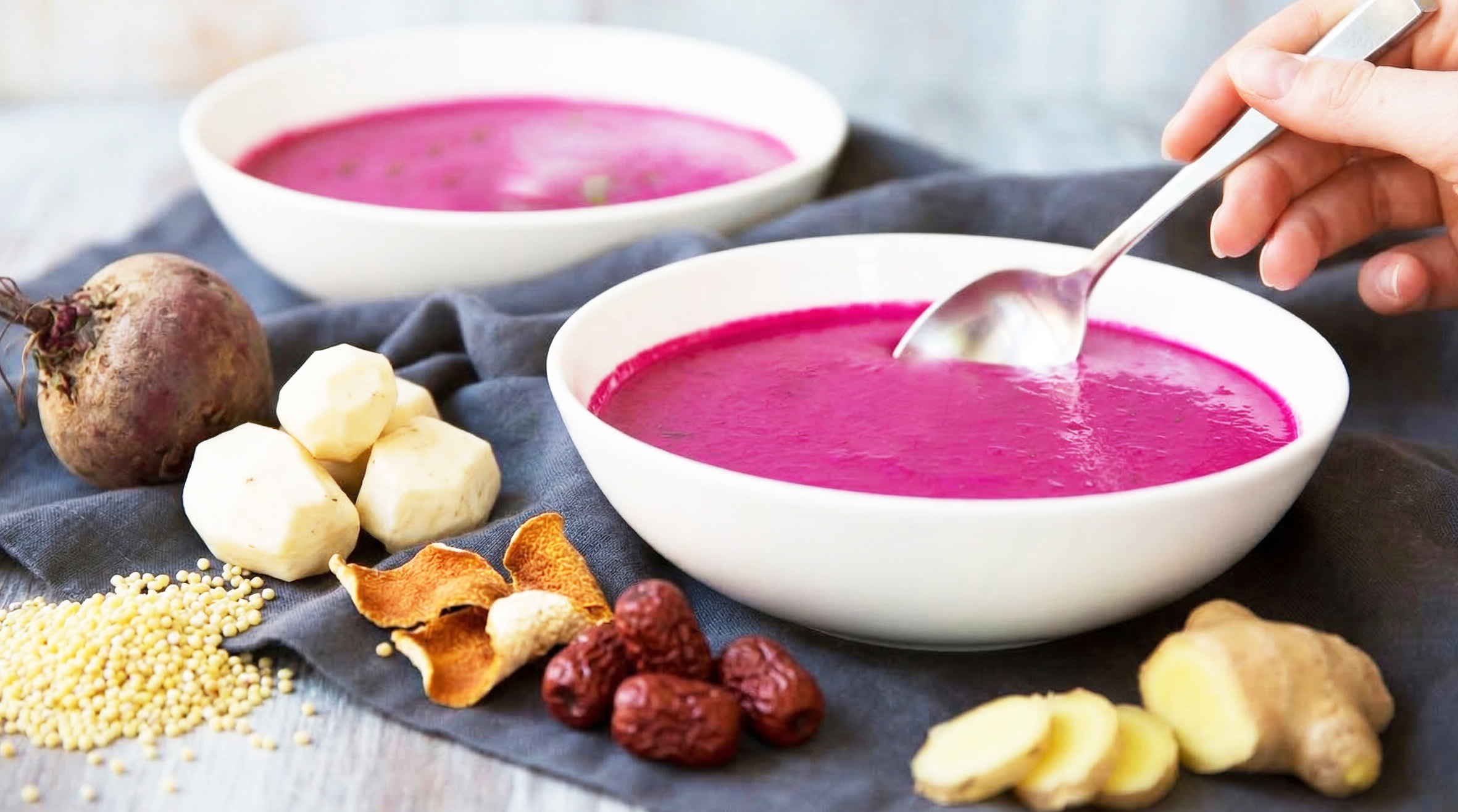
《 Professional Interpretation & Dietary Application of Beetroot 》
1. Nature, Tasteand Meridian
Nature & Taste: Sweet, Neutral (slightly cooling when eaten raw)
Meridian Entered: Liver, Spleen, Lung meridians
Professional Interpretation
In Traditional Chinese Medicine (TCM), the sweet flavour is associated with tonifying, harmonizing, and moderating effects within the body. It helps nourish the system, support digestion, and promote the production of body fluids, thereby relieving dryness.
The sweetness of beetroot mainly comes from its rich natural sugars (sucrose, glucose, and fructose) as well as various vitamins. These nutrients can quickly provide energy for the body. At the same time, beetroot is naturally juicy, which helps generate body fluids and moisten dryness, supporting overall hydration according to TCM principles.
Its neutral nature (while slightly cooling when consumed raw) makes beetroot relatively balanced and suitable for most body constitutions. When cooked, its nature becomes even gentler and more balanced, further enhancing its ability to strengthen the Spleen and harmonize the digestive system.
Another noteworthy characteristic is its deep red colour, which in TCM theory is associated with the Blood aspect of the body. Its shape resembles the heart, and both traditional wisdom and modern observations suggest that it follows the principle of “like nourishes like”, where foods resembling certain organs are believed to benefit those organs. Beetroot is therefore considered to help nourish Blood, promote circulation, and clear heat from the Blood.
Because the root grows deeply in the soil, it is considered to absorb abundant Earth energy, which in TCM corresponds to the Spleen and Stomach systems. This gives beetroot the ability to strengthen the body’s central energy (Qi) and support digestion. At the same time, its red colour connects it to the Heart and Liver systems, enabling it to support blood circulation and help cool the Blood.
As recorded in the Chinese Materia Medica (Zhonghua Bencao), beetroot possesses the function of “clearing heat and cooling the Blood.” In traditional dietary practices, it has also long been used as a food ingredient believed to help purify and nourish the Blood.
2. Core Conceptsin Traditional Chinese Medicine (TCM)
In Traditional Chinese Medicine (TCM) health theory, the core value of beetroot lies in its ability to nourish Blood, promote Blood circulation and clear heat and toxicity from the Blood level.
Nourishing and Activating Blood:
In TCM, it is said that “Blood is the mother of Qi, and Qi is the commander of Blood.” The abundance and smooth circulation of Blood are fundamental to overall health. Beetroot, with its deep red colour, is believed to enter the Heart and Liver meridians. In TCM theory, the Heart governs the Blood and vessels, while the Liver stores Blood. Its rich red juice is therefore traditionally viewed as nourishing to the Blood of the Heart and Liver. At the same time, beetroot is believed to help promote the circulation of Qi and Blood, helping to prevent stagnation. From a dietary therapy perspective, it may support conditions associated with Blood deficiency or stagnation, such as a pale or sallow complexion, brittle or dull nails, scanty menstruation, or dark menstrual blood with clots.
Clearing Heat and Resolving Toxicity from the Blood:
In TCM, the concept of “toxicity in the Blood” refers to the accumulation of pathogenic factors such as heat or damp-heat within the Blood level. These imbalances may manifest as skin infections, boils, swelling, eczema, or inflammatory skin conditions. Beetroot has a neutral to slightly cooling nature and is believed to act on the Blood level, giving it the function of cooling the Blood and helping to resolve toxicity. By reducing internal heat and improving the body’s internal environment, it may support the improvement of skin issues associated with Blood heat or accumulated toxins.
“The Liver Stores Blood, the Spleen Governs Blood, and the Heart Controls Blood”: Beetroot is believed to support these systems simultaneously. By strengthening the Spleen (Earth), it supports the production of Qi and Blood. By entering the Liver (Wood), it supports the storage and smooth circulation of Blood. By influencing the Heart (Fire), it enhances the driving force behind blood circulation. Through this integration action, beetroot helps optimise the condition of the Blood system as a whole—from its generation and storage to its circulation—thereby nourishing and activating Blood. For individuals experiencing excessive mental strain that depletes Heart Blood, or internal imbalances caused by poor dietary habits and accumulated damp-heat, beetroot offers a unique dietary therapeutic advantage by providing both nourishment and gentle cleansing at the same time.
3. Supporting Evidence from Modern Nutritional Science
Modern nutritional research shows that the traditional benefits of beetroot are closely related to its unique nutritional composition.
Betanin (Beetroot Pigment):
Betanin is a powerful antioxidant phytochemical found in beetroot and is responsible for its vibrant red color. Research has shown that betanin possesses significant anti-inflammatory, antioxidant, and free radical–scavenging properties. It helps protect vascular endothelial cells and reduces the oxidation of low-density lipoprotein (LDL), which may help prevent atherosclerosis. These findings provide a modern scientific explanation for the TCM concept of “promoting blood circulation and resolving toxicity from the Blood”. By reducing oxidative stress and inflammatory responses, betanin helps maintain the health of both the Blood and blood vessels.
Nitrates:
Beetroot is an excellent natural source of dietary nitrates. After consumption, nitrates are converted in the body into nitric oxide (NO). Nitric oxide is a key vasodilator that relaxes blood vessels, lowers blood pressure, and improves blood flow and oxygen delivery to muscle tissues. This enhances physical endurance and exercise performance. This discovery strongly supports the traditional TCM understanding of beetroot’s ability to “invigorate and promote the movement of Blood.” Modern science confirms that beetroot can improve circulation through well-understood physiological mechanisms.
Folate (Vitamin B9) and Iron:
Beetroot is rich in folate, a vitamin essential for red blood cell formation, DNA synthesis, and cell division. It also contains plant-based (non-heme) iron, together with vitamin C, may support the prevention of certain types of anemia. This provides a direct nutritional basis for the TCM concept of “nourishing the Blood.” Beetroot is therefore particularly suitable for women preparing for pregnancy, pregnant women, growing children, and individuals prone to anemia.
Dietary Fiber and Betaine:
Beetroot contains abundant dietary fiber, especially pectin, which helps promote intestinal movement, relieve constipation, and regulate gut microbiota balance as a prebiotic. In TCM theory, the Lung and Large Intestine are internally–externally related. Healthy intestinal function supports the Lung’s dispersing and descending functions and indirectly benefits skin health and metabolism. Betaine, another key component, an important methyl donor that supports liver function, fat metabolism, and cardiovascular health by reducing homocysteine (Hcy) levels.
【Additional Key Point】Natural Energy Booster and Athletic Performance:
Beetroot combines natural sugars for energy, nitrates for oxygen delivery, and antioxidants for fatigue reduction, making it an excellent natural performance-enhancing food. It provides sustained and efficient energy support while helping delay fatigue, which closely aligns with the TCM concept that strengthening Qi and nourishing Blood enhances vitality and endurance.
4. Summary of Core Effects
Nourishing and activating Blood:
Address conditions related to Blood deficiency such as a dull complexion, pale lips and nails, palpitations, and insomnia, as well as Blood stasis conditions manifesting as menstrual pain and a dark, lackluster complexion.
Cooling the Blood and resolving toxicity:
Address conditions caused by Blood heat, including skin sores, acne, eczema, dry mouth and throat, and blood in the stool.
Strengthening the Spleen and harmonizing the Middle Burner:
Address conditions related to Spleen Qi deficiency, such as poor appetite, indigestion, fatigue, and low energy.
Moistening the intestines and promoting bowel movement:
Address conditions for dryness-related constipation and difficulty in defecation.
5. Traditional Dietary Recipes with Modern Adaptation
Beetroot – Vitality Nourishing Porridge
Core Effects: Strengthens the Spleen and replenishes Qi, nourishes Blood and restores vitality, reinforces body resistance and secures the foundation.
Best suited for:
- Recovery phase of chronic illness: Post-surgery (such as tumor removal), post-chemotherapy or radiotherapy, or long-term medication use, presenting a fatigue, poor appetite, and pale complexion.
- Qi and Blood deficiency: Dizziness, palpitations, shortness of breath, insomnia with frequent dreams, pale lips and nails.
- Weak Spleen and Stomach: Poor appetite, loose stools, bloating after meals, fatigue of the limbs, and muscle wasting.
- Elderly with low vitality: Declining energy, soreness in the lower back and knees, weakened immunity, and frequent colds.
Ingredients (1–2 servings)
1. Fresh Beetroot – 50 gm
- Nature & Meridian: Sweet, neutral; enters Liver, Spleen, Lung meridians
- Benefits: Cools the Blood, resolves toxicity, and clears heat from the Blood level.
2. Fresh Chinese Yam (Shan Yao) – 50 gm
- Nature & Meridian: Sweet, neutral; enters Spleen, Lung, Kidney meridians
- Benefits: Strengthens the Spleen and replenishes Qi while gently nourishing both Qi and Yin, providing a stable energy foundation for the body.
3. Millet – 20 gm
- Nature & Meridian: Sweet, slightly salty, cooling; enters Kidney, Spleen, Stomach meridians
- Benefits: Harmonizes the middle burner, nourishes Stomach Qi, and supports Kidney essence.
4. Aged Tangerine Peel (Chen Pi) – 1 small pc (about 1–2 gm)
- Nature & Meridian: Pungent, bitter, warm; enters Spleen and Lung meridians
- Benefits: Regulates Qi, strengthens the Spleen, dries dampness, and transforms phlegm, ensuring the nourishing formula remains light and easy to digest.
5. Red Dates (Jujube) – 2 pcs
- Nature & Meridians: Sweet, warm; enters Spleen, Stomach, Heart meridians
- Benefits: Tonifies the middle and boosts Qi, nourishes Blood, and calms the mind.
6. Fresh Ginger – 2 slices
- Nature & Meridian: Pungent, slightly warm; enters Lung, Spleen, Stomach meridians
- Benefits: Warms the middle burner, disperses cold, harmonizes the Stomach, and alleviates nausea.
7. Filtered Water– 600 ml
Preparation
- Pre-preparation: Peel the beetroot and Chinese yam, then cut them into small pieces.
- Rinse the millet thoroughly. Remove the seeds from the red dates and tearthemslightly. Soak the aged tangerine peel briefly in warm water to soften it.
- Place all ingredients into theiTAZZOi-Processor, blend at Speed 8 for 10 minutes until the mixture becomes smooth and creamy.
Consumption Tips and Precautions
- Best Time: Breakfast (7–9 AM), corresponding to the Stomach meridian peak time in TCM. At this time, the body’s Yang energy is rising and the digestive system is strongest, making it the ideal time for nourishment. It is recommended to drink warm and sip slowly.
- Frequency: Gradual and consistent consumption is key. 3–4 times per week as a nourishing breakfast for long-term wellness nourishment. For individuals with severe weakness, consume daily for 2-3 weeks, then reduced to 2–3 times per week once appetite and energy levels improve.
- Important Reminders:
- Syndrome differentiation: This formula is gentle and primarily nourishing. However, it is not suitable during acute infections (fever, sore throat with swelling), excess heat (constipation, foul breath), or phlegm-damp accumulation (cough with thick yellow phlegm)
- Personal adjustments: Honey or dates may be added after cooling slightly to preserve nutrients.
- Observation: For individuals with chronic illness or significant weakness, start with half a serving (about 300 ml) to observe the body’s response such as bloating or internal heat before increasing dose. This reflects the TCM principle of gradual tonification for deficiency conditions.
《甜菜根的专业解读与食疗应用》
一、 性味归经
性味:甘,平(生食微凉)归经:肝、脾、肺经
【专业解读】
其“甘”味能补、能和、能缓,具有补益和中、生津滋润的作用。甜菜根之“甘”,主要源于其丰富的天然糖分(蔗糖、葡萄糖、果糖)和多种维生素,能为人体快速补充能量,同时其汁液丰沛,能生津润燥。
其“平”性(生食偏凉)使其性质较为中和,适用于多数体质。煮熟后其性更趋于平缓,增强了健脾和中的作用。尤其值得注意的是,它色红入血分,形似心脏,传统智慧与现代科学均发现其能“以形补形”,在养血活血、清解血毒方面有独到之处。其根茎深植于土,得土气最厚,故能入脾胃,补中气;其色红又入心肝,能行血凉血,具有独特的“血脏”亲和力。正如《中华本草》所载其“清热凉血”之功,民间亦有将其作为清血、净血食材使用的传统。
二、 传统中医理论核心
在中医养生理论中,甜菜根的核心价值在于 “养血活血” 与 “清解血毒”。
养血活血:中医认为“血为气之母,气为血之帅”,血的充盈与通畅是健康的根本。甜菜根色赤,入心、肝二经,心主血脉,肝藏血。其红色汁液被视为能直接滋养心肝之血,有“补血养血”之效。同时,它能促进气血运行,防止血瘀,对于面色萎黄、爪甲不荣、月经量少、血色暗沉有块等血虚、血瘀之象,有积极的食疗调养作用。
清解血毒:所谓“血毒”,是中医对体内热毒、湿浊等病邪侵入或蕴结于血分的概括,常表现为皮肤疮疡、痈肿、湿疹、以及部分热性🎧血等。甜菜根性平而微凉,入血分,有“凉血解毒”之功。它能够帮助清除血分中的热毒,净化血液环境,从而改善因血热、血毒引起的皮肤问题。
“肝藏血,脾统血,心主血”:甜菜根通过补脾(土)以使气血生化有源(脾统血),通过入肝(木)以助疏泄和储藏血液(肝藏血),通过入心(火)以加强血脉的推动力(心主血)。这种多脏器的综合作用,使其能系统性地优化“血”的状态,从生成、储藏到运行,全方位地“养血活血”。对于思虑过度、耗伤心血,或饮食不节、湿热内蕴导致的血分问题,甜菜根能发挥其清补并用的独特优势。
三、 现代营养科学佐证
现代营养学分析表明,甜菜根的传统功效与其独特的营养成分密不可分
- 甜菜红素(Betanin):这是甜菜根中一种具有强效抗氧化作用的植物化学物,也是其鲜艳红色的来源。研究表明,甜菜红素具有显著的抗炎、抗氧化和清除自由基能力,能够保护血管内皮细胞,减少低密度脂蛋白(LDL)的氧化,从而有助于预防动脉粥样硬化。这为中医“活血、清解血毒”的理论提供了现代分子层面的解释。它通过减少氧化应激和炎症反应,维护血液和血管的健康状态。
- 硝酸盐(Nitrate):甜菜根是膳食硝酸盐的极佳来源。摄入后,硝酸盐在体内可转化为一氧化氮(NO)。一氧化氮是重要的血管舒张因子,能够扩张血管、降低血压、增加肌肉组织的血流量和氧
- 气供应,从而提升运动耐力。这一发现完美地佐证了甜菜根“活血”、“行血”的传统功效,说明它能通过现代科学证实的生理机制,改善血液循环。
- 叶酸(维生素 B9)与铁:甜菜根富含叶酸,这是红细胞生成、DNA 合成和细胞分裂所必需的维生素。同时,它也含有一定量的铁元素,虽然为植物性非血红素铁,但在叶酸和维生素 C 的协同作用下,仍有助于改善和预防贫血。这为“养血”提供了直接的营养基础,特别适合备孕及孕期女性、生长发育期儿童及贫血倾向者。
- 膳食纤维与甜菜碱(Betaine):甜菜根富含膳食纤维,特别是果胶,能促进肠道蠕动、改善便秘,同时作为益生元调节肠道菌群。中医认为“肺与大肠相表里”,肠道健康有助于肺气的宣发肃降,并间接影响皮肤的代谢。此外,甜菜碱是重要的甲基供体,具有保护肝脏、促进脂肪代谢、降低同型半胱氨酸(Hcy)水平的作用,有助于维护心血管健康。
【补充关键点】天然能量补充剂与运动表现:甜菜根集快速供能的天然糖分、提升携氧能力的硝酸盐、以及抗疲劳的抗氧化剂于一身,是一种理想的天然运动营养食品。它能提供持久而高效的能量支持,延缓疲劳,这与中医“补中气、养气血”后体力增强、精神健旺的效果不谋而合。
四、 核心功效总结
- 养血活血:针对面色无华、唇甲色淡、心悸失眠等血虚证,以及血瘀引起的痛经、面色晦暗等。
- 凉血解毒:针对血热引起的皮肤疮疡、粉刺、湿疹、口干舌燥、便血等。
- 健脾和中:针对食欲不振、消化不良、体倦乏力等脾虚气弱证。
- 润肠通便:针对肠燥便秘、排便不畅。
五、 食疗古方新制
甜菜根 ~ 元气羹
主治:健脾益气,养血培元,扶正固本
最佳体征:
- 慢性病康复期:肿瘤术后、放化疗后、长期服药导致的体虚乏力、食欲不振、面色苍白。
- 气血两亏:头晕目眩、心悸气短、失眠多梦、唇甲色淡。
- 脾胃虚弱:食少便溏、饭后腹胀、四肢倦怠、肌肉消瘦。
- 老年体虚:精力衰退、腰膝酸软、免疫力低下、易感冒。
食材(1-2 人份):
1.甜菜根(鲜):50 gm
- 性味归经:甘,平;归肝、脾、肺经。
- 功效:凉血解毒,清解血分热毒。
2. 山药(鲜):50 gm
- 性味归经:甘,平;归脾、肺、肾经。
- 功效:健脾益气,平补气阴,为身体打下坚实的能量基础。
3. 小米:20 gm
- 性味归经:甘、咸,凉;归肾、脾、胃经。
- 功效:和中益肾,养护胃气。
4. 陈皮:1 小块(约 1-2 克)
- 性味归经:辛、苦,温;归脾、肺经。
- 功效:理气健脾,燥湿化痰,使全方补而不腻。
5.红枣:2 枚
- 性味归经:甘,温;归脾、胃、心经。
- 功效:补中益气,养血安神。
6. 生姜:2 片
- 性味归经:辛,微温;归肺、脾、胃经。
- 功效:温中散寒,和胃止呕。
7. 过滤水:600 ml(用于生饮版)
做法:
- 提前处理:甜菜根、山药去皮切小段。
- 小米淘洗干净;红枣去核撕开;陈皮用温水稍泡软。
- 将所有食材放入 iTAZZO 智能养生机中,设定档速8号,搅打10分钟至细腻顺滑即可。
饮用宜忌与温馨提示:
- 黄金饮用时间:早餐(辰时,7-9 点,胃经当令),此时阳气升发,脾胃运化能力最强,最宜进补。建议温热饮用,小口慢咽。
- 饮用频率:循序渐进,贵在坚持。建议每周 3-4 次,作为长期调养的早餐。体虚严重者可连续饮用 2-3 周观察,待食欲、体力好转后,改为每周 2-3 次巩固。
- 核心提醒:
- 辨证使用:此方性质温和,重在平补。但急性感染期(发烧、咽喉肿痛)、实热证(便秘、口臭)、痰湿壅盛(咳嗽痰多黄稠)者暂不宜,需待急症缓解后再行调理。
- 个体化调整:如感觉甜味不够,可加入少许椰枣或蜂蜜(待稍凉后加入,避免高温破坏蜂蜜营养)。
- 观察反应:慢性病、体虚人群初次尝试时,建议从半量开始(约 300ml),观察身体有无腹胀、上火等不适反应,再逐渐加至正常量。这符合中医“虚人缓补”的原则。