《 Professional Interpretation & Dietary Application of Cucumber 》
1.Nature,Tasteand Meridian
Nature & Taste: Sweet, Cooling
Meridian Entered: Spleen, Stomach, Small Intestine, Large Intestine meridians
Professional Interpretation
In Traditional Chinese Medicine (TCM), the sweet flavour has the functions of tonifying, harmonizing, and moderating. Cucumber’s sweet flavour enables it to clear heat, promote the production of body fluids, replenish fluids, and facilitate urination. Its sweetness comes primarily from its exceptionally high water content (approximately 96%), together with a variety of vitamins and minerals. These nutrients help gently replenish body fluids and nourish the body’s organ systems.
Its cooling nature makes cucumber particularly suitable for individuals with heat-dominant constitutions, those affected by summer heat, or those experiencing Yin deficiency accompanied with internal heat. With its green colour and elongated shape, cucumber is regarded as being rich in the nourishing qualities of water. It primarily enters the Spleen, Stomach, and Large Intestine meridians, where it helps clear internal heat and eliminate heat toxins.
In the Five Elements theory, the colour green corresponds to the Wood element and is associated with the Liver and Gallbladder. However, because cucumber is cooling in nature and primarily enters the Spleen and Stomach meridians, it is especially effective at clearing heat from the Middle burner (digestive system).
Its cooling properties help reduce excess internal heat, making it beneficial for symptoms caused by excessive Stomach heat, including:
- Dry mouth and tongue
- Excessive thirst
- Dark yellow urine
Classical TCM literature has long documented these traditional uses:
- Compendium of Materia Medica (Ben Cao Gang Mu) records that cucumber “relieves thirst and promotes urination.”
- Supplement to the Compendium of Materia Medica (Ben Cao Gang Mu Shi Yi) describes cucumber as “clearing heat, relieving thirst, and promoting urination.”
- Daily Materia Medica (Ri Yong Ben Cao) states that cucumber “clears heat from the chest and relieves thirst.”
Traditionally, cucumber has also been used externally to soothe minor burns and consumed internally to help relieve summer heat and replenish body fluids.
2. CoreConceptsin Traditional Chinese Medicine (TCM)
In Traditional Chinese Medicine (TCM), cucumber is valued primarily for its ability to clear heat and relieve thirst, promote urination and reduce oedema, and clear heat toxins while nourishing the skin.
Clearing Heat and Relieving Thirst
One of the fundamental therapeutic principles in TCM is “treat heat with cooling.” With its cooling nature and sweet flavour, cucumber enters the Spleen and Stomach meridians, making it particularly effective in clearing heat from the Middle Burner (digestive system).
When excessive Stomach heat accumulates, common symptoms may include:
- Dry mouth and tongue
- Excessive thirst
- Irritability
- An unusual strong appetite despite frequent eating (known in TCM as “rapid digestion with excessive hunger”)
Like a refreshing spring, cucumber replenishes body fluids while clearing internal heat. It is especially beneficial during hot summer weather, when summer heat consumes body fluids and give rise to symptoms such as:
- Elevated body temperature
- Thirst
- Restlessness
- Dryness
As a dietary therapy, cucumber helps restore body fluids, dispel heat, and gently return the body to a state of coolness and proper hydration. It is like a timely rain that cools and overheated body and restores moisture and comfort.
Promoting Urination and Reducing Oedema
According to TCM, cucumber enters the Small Intestine and Bladder meridians. Its naturally light, cooling, and permeating properties facilitate the movement of water, promote urination, and support normal fluid metabolism.
It is used for conditions associated with water retention and dampness, including:
- Difficulty urinating
- Generalized or localized oedema (especially swelling of the lower limbs)
- Dark yellow or painful urination caused by damp-heat
through the TCM well-known therapeutic principle “promote urination to facilitate bowel function”. By encouraging the elimination of excess water and damp-heat through urination, cucumber helps restore the body’s normal fluid balance and support the resolution of oedema.
Unlike some strongly diuretic herbs and food, cucumber promotes urination without significantly depleting Yin or body fluids. This makes it particularly suitable for individuals who experience both oedema and dryness—a relatively uncommon combination among foods that promote urination.
Detoxifying and Nourishing the Skin
Cucumber has long been valued in TCM for its ability to clear heat toxins and support healthy skin. Its cooling nature helps alleviate heat-related conditions, such as:
- Internally, to help relieve red, inflamed eyes and sore throat
- Externally, as mashed cucumber applied to the skin to moisturize, soothe, and soften the complexion while helping reduce the appearance of fine lines.
These traditional applications are documented in both the Compendium of Materia Medica (Ben Cao Gang Mu) and Chinese Materia Medica (Zhonghua Ben Cao). Fresh cucumber slices have also long been used in folk practice as a natural skincare remedy. Because of its gentle cooling nature, cucumber is particularly suitable for individuals with Yin deficiency accompanied by internal heat and dryness, as it cools without damaging the body’s healthy Qi.
“Where Excess Heat Accumulates, Swelling Develops; When Heat Is Cleared, Swelling Subsides”: cucumber clears heat and promoting urination, therefore it relieves symptoms associated with excessive Stomach heat and the accumulation of damp-heat such as dry mouth, dark yellow urine, oedema and heat-related sores and inflammatory skin eruptions. This therapeutic strategy of “clearing heat first, then promoting urination” enables cucumber to address a wide range of discomforts arising from Stomach heat ascending upward and damp-heat descending downward.
For individuals recovering from prolonged illness or experiencing Yin deficiency with internal heat, cucumber provides gentle cooling and nourishing Yin. It replenishes body fluids gradually without contributing to the accumulation of dampness. Its ability to clear heat toxins and nourish the skin naturally complements its functions of clearing heat and promoting healthy fluid metabolism. In TCM, when heat toxins are eliminated and water pathways flow smoothly, the skin naturally becomes clearer, smoother, with radiant appearance.
3. Supporting Evidence from Modern Nutritional Science
Modern nutritional research indicates that many of cucumber’s traditional health benefits are closely related to its unique nutritional composition.
Silica
Cucumber skin contains silica, with relatively higher concentrations found around the small bumps or spine-like projections on the surface. Silica is an important trace mineral involved in the formation and maintenance of connective tissue, bones and cartilage. It also plays a role in collagen synthesis, helping maintain skin elasticity, bone strength and joint health. This provides a modern nutritional explanation for cucumber’s traditional use in nourishing skin health and helping reduce the appearance of wrinkles.
Cucurbitacin C
Cucumber contains Cucurbitacin C, a naturally occurring triterpenoid compound that functions as part of the plant’s natural defence system. Laboratory and animal studies suggest that cucurbitacin may possess anti-inflammatory properties and immune-modulating effects. However, evidence in human remains limited, and further well-designed clinical studies are needed before definitive conclusions can be drawn.
These compounds may represent one possible biological basis for cucumber’s traditional TCM function of “clearing heat and resolving heat toxins.”
Malonic Acid
Cucumber contains malonic acid, an organic acid that has attracted scientific interest. Experimental studies have suggested that malonic acid may inhibit certain enzymes involved in the conversion of carbohydrates into fat. However, it is important to note that these findings are primarily based on laboratory research. At present, there is insufficient clinical evidence in humans to determine whether the same effects occur to a meaningful extent. Cucumber’s role in weight management is supported far more directly by its low energy density, high water content, and ability to promote satiety, rather than by the effects of malonic acid alone.
Potassium
Cucumber is a good source of potassium, providing approximately 147–200 mg per 100 gm, depending on the variety. Potassium is an essential mineral that helps maintain intracellular osmotic balance, regulate fluid and electrolyte balance and support normal nerve and muscle function. Adequate potassium intake also helps counteract the blood pressure–raising effects of excess sodium by promoting urinary sodium excretion, thereby contributing to healthy blood pressure regulation. This provides an important nutritional explanation for cucumber’s traditional TCM function of promoting urination and reducing oedema.
High Water Content
Cucumber consists of approximately 95–96% water, making it one of the most hydrating commonly consumed vegetables. Its exceptional high water content helps:
- Maintain adequate hydration
- Replenish body fluids
- Support the elimination of metabolic waste
- Contribute to normal metabolic processes
At the same time, cucumber provides very few calories, making it an ideal food for hydration without adding a significant energy burden. This high water content provides the most direct nutritional explanation for cucumber’s traditional TCM function of clearing heat and relieving thirst.
Vitamin K
Cucumber contains approximately 16–20 μg of vitamin K per 100 g. Vitamin K is essential for the production of blood clotting factors in the liver and the activation (carboxylation) of osteocalcin, an important protein involved in bone formation and mineralisation. Adequate vitamin K intake contributes to the maintenance of healthy bone.
Antioxidant Compounds
Cucumber contains a variety of naturally occurring antioxidant compounds, including vitamin C (approximately 2–3 mg per 100 g), small amounts of beta-carotene and various flavonoids, including isoquercitrin. Together, these compounds exhibit antioxidant activity that may help neutralise free radicals, reduce oxidative stress and support overall cellular health. It should be noted, however, that cucumber is not a particularly rich source of vitamin C. Its vitamin C is considerably lower than that of fruits such as citrus fruits and kiwifruit, and readers should be aware of this distinction.
Blood Sugar Regulation
Traditional claims of cucumber “does not participate in sugar metabolism” are an oversimplification. In reality, cucumber contains very little carbohydrate (approximately 3–4 g per 100 g), much of which consists of dietary fibre, low in glycaemic index (GI), which has only a minimal impact on postprandial blood glucose levels. For this reason, it is a suitable snack or replacement for higher-carbohydrate foods in individuals with diabetes.
About “Cucumber Enzymes”
Some popular wellness articles claim that naturally occurring “cucumber enzymes” can enhance metabolism after consumption. From a scientific perspective, enzymes are proteins that are rapidly denatured by gastric acid and subsequently broken down by digestive enzymes in the gastrointestinal tract. Consequently, they cannot be absorbed in an active form after oral consumption, and there is no strong scientific evidence to support claims that consuming cucumber enzymes directly enhances metabolism. Likewise, there is no evidence that orally consumed cucumber enzymes exert direct effects on the skin. The skincare benefits traditionally associated with cucumber are more plausibly attributed to the combined effects of its high water content, silica and naturally occurring anti-inflammatory compounds, rather than to active enzymes.
【Additional Key Point】Nature’s Hydration and Electrolyte Booster
Combining high water content, low energy density, and a moderate amount of potassium, cucumber is an excellent food for maintaining hydration during hot weather, supporting daily fluid replenishment, and promoting overall wellness in individuals with heat-dominant constitutions according to TCM.
Its key nutritional benefits include:
- High water content to help replenish body fluids and maintain hydration
- Low calorie content that supports hydration without adding a significant metabolic burden
- Potassium, which helps maintain electrolyte balance and supports healthy fluid regulation
These benefits closely align with the TCM principles of “clearing heat, promoting the production of body fluids, and facilitating healthy water metabolism to reduce fluid retention.” In addition, compounds such as silica and cucurbitacin C contribute to cucumber’s traditional reputation for supporting healthy skin and its potential anti-inflammatory properties, making it an excellent choice as part of a balanced diet and daily wellness program.
4. Summary of CoreEffects
Clearing Heat and Relieving Thirst
Suitable for conditions associated with internal heat and depletion of body fluids, including:
- Thirst caused by summer heat
- Dry mouth and tongue
- Sore throat
- Excessive appetite associated with Stomach heat
Promoting Urination and Reducing Oedema
Supports conditions related to water retention and dampness, including:
- Difficulty urinating
- Generalized or localized oedema
- Dark yellow urine associated with damp-heat accumulation
Detoxifying – Clearing Heat Toxins
Traditionally used to support conditions associated with heat toxins, including:
- Red, inflamed eyes (“fire-eye” or heat-related eye inflammation)
- Minor burns (when applied externally)
- Heat-related skin sores and inflammatory skin conditions
Nourishing the Skin and Supporting Healthy Aging
Beneficial for individuals with:
- Dry skin
- Fine lines and wrinkles
- Loss of skin moisture and vitality
Supporting Healthy Blood Sugar and Lipid Metabolism
May provide supportive benefits for individuals with:
- Diabetes (as part of blood sugar management)
- Overweight or obesity
- Elevated blood lipids levels
Supporting Healthy Blood Pressure
May help individuals with:
- High blood pressure
- Water retention related to excess sodium
5. Traditional Dietary Recipe with Modern Adaptation
Cucumber is cooling in nature and has traditionally been used in dietary therapy for summer heat, fluid retention, excessive thirst, and water retention. Based on modern nutritional science, the following recipes are designed to support 4 key wellness goals:
- Promotingbettersleep and relieving stress
- Supporting liver health and recovery after alcohol consumption
- Supporting healthy aging and skin nourishment
- Supporting calcium intake and bone health
Using high-speed blending technology to maximise the utilisation of whole-food nutrients, these recipes are suitable for vegetarians, including lacto-ovo vegetarians and individuals using plant-based milk alternatives.
Indications: Promoting Better Sleep and Relieving Anxiety
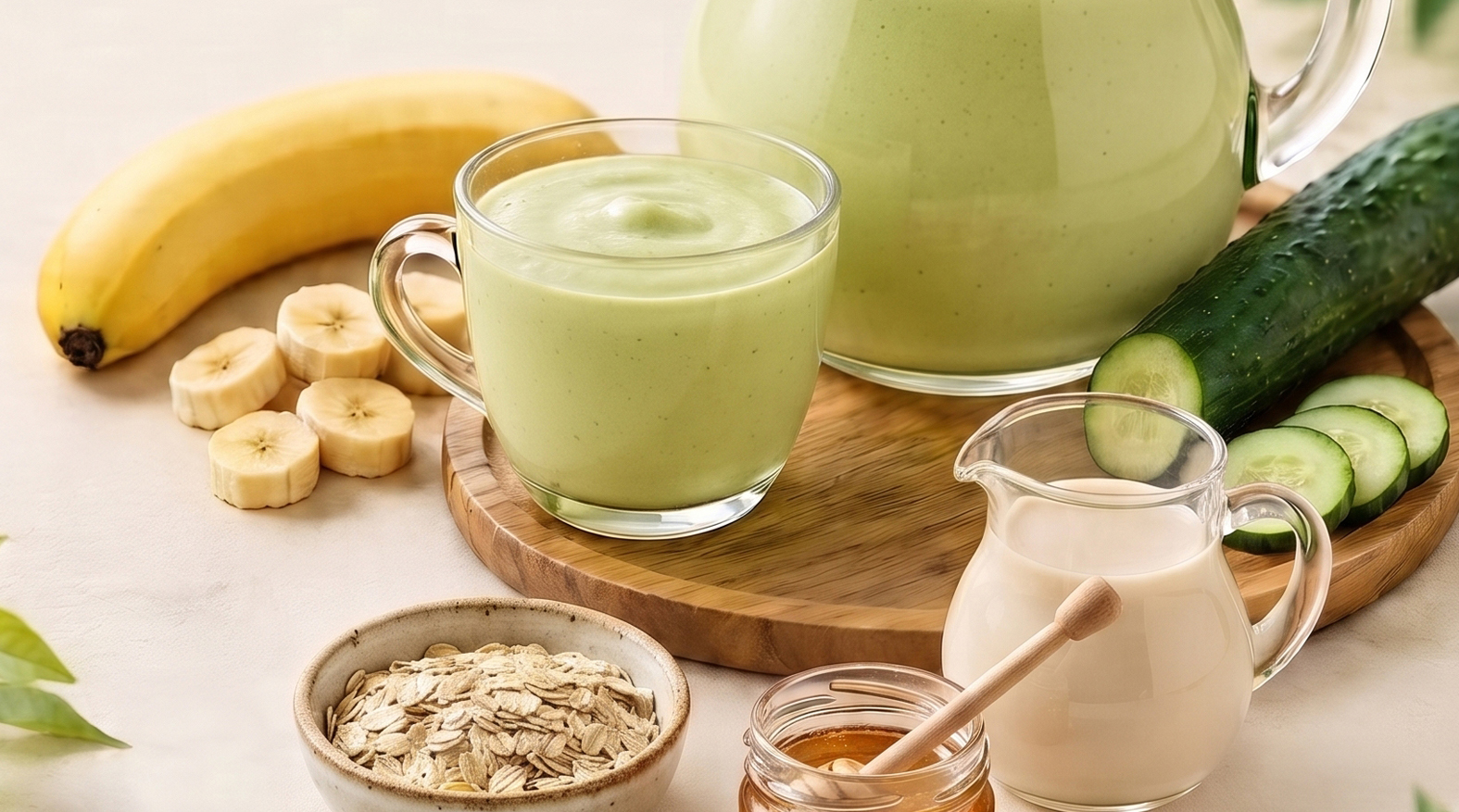
Cucumber – Calming Sleep Support Drink
Best suited for Individuals experiencing sleeping issues, including:
- Difficulty falling asleep
- Light sleep with frequent waking
- Excessive dreaming
- Noticeable daytime fatigue and reduced energy
- Persistent feelings of tension, nervousness, or anxiety without an obvious external cause
Ingredients (1 serving)
- Japanese Cucumber-1/2pc
- Banana – 1 whole
- Rolled Oats – 30 gm
- Oat Milk – 250 ml
- Honey – 1 teaspoon (optional)
Preparation
- Wash the cucumber thoroughly with salt water and cut into chunks.
- Peel and cut the banana into sections.
- Place all ingredients except the honey into the iTAZZO i-Processor, blend at speed 6 for 3 minutes until smooth.
- Pour into a cup and stir in the honey, if desired.
Consumption Tips and Precautions
Best Time:
- Consume warm, about 1–1.5 hours before bedtime.
- Avoid drinking immediately before going to bed, as the increased fluid intake may cause nighttime urination and interrupt sleep.
Frequency:
- For general sleep support: 3–4 times per week
- During periods of significant anxiety or insomnia: Once daily for 2–4 consecutive weeks
Important Reminders:
Especially Recommended For:
- Individuals with long-term sleep difficulties
- Those with noticeable anxiety, emotional tension or mental stress
- Working adults and students experiencing daytime fatigue
Most Suitable For:
Individuals with a heat-dominant constitution or insomnia associated with Yin deficiency and internal heat.
《 ⻩⽠的专业解读与⻝疗应⽤》
⼀、性味归经
性味:⽢,凉
归经:脾、胃、⼩肠、⼤肠经
【专业解读】
其“⽢”味能补、能和、能缓,具有清热⽣津、补⽔利尿的作⽤。⻩⽠之“⽢”,源于其丰富的天然⽔分(约96%)及多种维⽣素与矿物质,能温和地为⼈体补充津液,滋养五脏六腑。
其“凉”性使其性质清寒,尤其适合热性体质、暑热烦渴、阴虚⽕旺之⼈。⻩⽠⾊⻘绿,形⻓,得⽔⽓最⾜,故能直⼊脾胃⼤肠,⼤清热毒。⻘⾊在五⾏中属⽊,对应肝胆,但⻩⽠以凉性⼊脾胃,故能清中焦之热。其性凉能泻⽕,对于胃热炽盛引起的⼝⼲⾆燥、⼩便⻩⾚有很好的清热效果。
《本草纲⽬》载⻩⽠能“解烦渴,利⽔道”,《本草纲⽬拾遗》称其“清热解渴,利⽔道”,《⽇⽤本草》谓其“除胸中热,解烦渴”,⺠间亦有⽤⻩⽠外敷治疗烫伤、内服清解暑热的传统。
⼆、传统中医理论核⼼
在中医养⽣理论中,⻩⽠的核⼼价值在于 “清热⽌渴”、“利⽔消肿”与“解毒润肤”。
清热⽌渴
中医认为“热者寒之”。⻩⽠性凉味⽢,⼊脾胃经,最能清解中焦之热。胃热炽盛则⻅⼝⼲⾆燥、烦渴引饮、消⾕善饥(易饿)。⻩⽠如⼀股清泉,能迅速补充津液、清除热邪。对于夏季暑热伤津所致的身热、⼝渴、⼼烦,⻩⽠有极佳的⻝疗调养作⽤。它如同给燥热的身体降下⼀场⽢霖,使其重新恢复清凉滋润。
利⽔消肿
⻩⽠⼊⼩肠、膀胱经,其淡渗之性能够通利⽔道、促进排尿。对于⽔湿内停所致的⼩便不利、全身或局部⽔肿(尤以下肢为甚),或湿热下注引起的⼩便⻩⾚、涩痛,⻩⽠通过“利⼩便以实⼤便”的⽅式,帮助排出多余⽔分和湿热之邪。其利⽔⽽不伤阴,尤其适合⽔肿伴有⼝⼲者——这在利⽔⻝材中较为罕⻅。
解毒润肤
⻩⽠在清热解毒和美容⽅⾯有独特价值。其性凉能解热毒,内服可辅助治疗⽕眼(红眼病)、咽喉肿痛,外⽤捣烂涂擦⽪肤有润肤、舒展皱纹之效。这⼀功效在《本草纲⽬》及《中华本草》中均有记载,⺠间亦常⽤⻩⽠切⽚敷⾯以美容。其性平和,不伤正⽓,尤宜于阴虚燥热体质者。
“热盛则肿,热去则消”: ⻩⽠通过清热利⽔,直接清除已⽣成的湿热之邪。对于因胃热炽盛、湿热内蕴引起的⼝⼲、尿⻩、⽔肿、疮疡,⻩⽠能发挥其“直折⽕势”的作⽤,快速清除热毒。这种“先清热,后利⽔”的思路,使其能系统改善因胃热上蒸、湿热下注引起的多种不适。⽽对于久病阴虚、虚⽕上炎之⼈,⻩⽠能提供其⽢凉滋润之⼒,缓缓养阴⽽不助湿。其“解毒润肤”之功,⼜与“清热利⽔”相辅相成——热毒清、⽔道通,则⽪肤⾃然光洁润泽。
三、现代营养科学佐证
现代营养学分析表明,⻩⽠的传统功效与其独特的营养成分密不可分:
硅酸(Silica): ⻩⽠表⽪含有硅,尤以果瘤/刺状部位相对集中。硅是⼈体结缔组织、⻣骼和软⻣形成过程中的微量元素,参与胶原蛋⽩合成,对维持⽪肤弹性、⻣骼强度、关节健康有积极作⽤。这是⻩⽠“润肤抗皱”功效的核⼼物质基础。
葫芦素C(Cucurbitacin C): ⻩⽠中的葫芦素C属于三萜类化合物,属于植物防御素,具有⼀定⽣物活性。体外和动物研究提示,葫芦素类化合物可能具有抗炎、调节免疫等作⽤,但在⼈体内的效应尚需更多研究验证。这是⻩⽠“清热解毒”功效可能的物质基础之⼀。
丙醇⼆酸: ⻩⽠含有丙醇⼆酸,这是⼀种有机酸。在实验研究中发现,丙醇⼆酸可以抑制糖类物质转化为脂肪的某些酶活性。但需要强调的是,该结论主要来⾃基础研究,在⼈体内是否有同样显著的效果,⽬前尚⽆充分的⼈体临床证据。⻩⽠低热量、⾼⽔分的特性是其“减肥”功效最直接的⽀撑,⽽⾮丙醇⼆酸。
钾元素: ⻩⽠富含钾(每100g约含147-200mg),钾是⼈体必需矿物质,参与维持细胞内渗透压和体液平衡。适量摄⼊钾有助于拮抗钠的升压作⽤,通过促进尿钠排泄,对⾎压调节有积极影响。这为“利⽔消肿”的传统功效提供了重要的营养学解释。
⽔分含量: ⻩⽠含⽔量⾼达95%-96%,在常⻅蔬果中名列前茅。充⾜的⽔分有助于维持身体⽔合状态,促进代谢废物排出,同时⼏乎不提供热量,是其“清热解渴”功效最直接的营养学⽀撑。
维⽣素K: ⻩⽠含有维⽣素K(每100g约含16-20μg),维⽣素K是肝脏合成凝⾎因⼦所必需的脂溶性维⽣素,同时参与⻣钙素的羧化过程,对⻣骼健康有⽀持作⽤。
抗氧化成分: ⻩⽠含有维⽣素C(每100g约含2-3mg,含量偏低)、β–胡萝⼘素 (微量)以及多种⻩酮类化合物(如异槲⽪素等)。这些成分共同具有⼀定的抗氧化活性,有助于清除⾃由基、减少氧化应激。⻩⽠中维⽣素C含量并不突出,远低于柑橘、猕猴桃等⽔果,读者应知悉此点。
关于降⾎糖的说法: 传统认为⻩⽠“不参与糖代谢”的说法过于简化。实际上,⻩⽠碳⽔化合物含量极低(每100g约含3-4g碳⽔),以膳⻝纤维为主,升糖指数很低,对⾎糖影响极⼩,适合糖尿病患者作为加餐或替代⾼碳⽔⻝物。
关于⻩⽠酶: 部分⺠间养⽣⽂章提及“⻩⽠酶”具有⽣物活性,可促进新陈代谢。实际上,酶(酵素)是蛋⽩质,⼝服后会在胃酸和消化酶作⽤下迅速变性失活,⽆法以活性形式被吸收或作⽤于⽪肤。因此,“⻩⽠酶”的⼝服功效缺乏科学依据。⻩⽠外敷时的美容效果,更多归因于其⽔分、硅酸和抗炎成分的综合作⽤。
【补充关键点】天然的“补⽔站”与“电解质来源”
⻩⽠集⾼⽔分、低热量、适量的钾于⼀身,是⼀种理想的夏季消暑、⽇常补⽔及热性体质保健⻝品。其核⼼营养学价值在于:⾼⽔分补充体液、低热量不增加代谢负担、钾元素⽀持体液平衡。这与中医“清热⽣津、利⽔消肿”的理论⾼度契合。⽽其硅酸和葫芦素等成分赋予了它独特的“润肤”和潜在“抗炎”价值,成为⽇常养⽣饮⻝的优质选择。
四、核⼼功效总结
清热⽌渴:针对暑热烦渴、⼝⼲⾆燥、咽喉肿痛、胃热消⾕善饥等热盛津伤证。
利⽔消肿:针对⼩便不利、全身或局部⽔肿、湿热下注引起的⼩便⻩⾚等⽔湿内停证。
解毒:针对⽕眼(红眼病)、烫伤(外敷)、疮疡肿毒等热毒证。润肤抗皱:针对⽪肤⼲燥、皱纹、⾯⾊暗沉等肌肤失养证。
降糖降脂:针对糖尿病(辅助控糖)、肥胖、⾼⾎脂等代谢紊乱证。辅助降压:针对⾼⾎压、⽔肿等⽔钠潴留证。
五、⻝疗古⽅新制
⻩⽠性凉,传统⻝疗多⽤于暑热、⽔肿、消渴之证。以下四⽅根据现代营养学佐证,精选改善睡眠缓解焦虑、护肝解酒、抗衰⽼、补钙健⻣四个功效⽅向,采⽤破壁机技术实现全营养吸收,均适配素⻝者(蛋奶素/植物奶)。
主治:安神助眠,缓解焦虑
⻩⽠~安神助眠饮
最佳体征:“不寐证”⼊睡困难、眠浅易醒、多梦纷纭;⽇间疲劳感明显、精⼒不济、精神紧张;特质性焦虑(⽆明显诱因的持续紧张感)。
⻝材(1⼈份):
- ⽇本⻩⽠ 半根
- ⾹蕉 1根
- 燕⻨⽚ 30gm
- 燕⻨奶 250ml
- 蜂蜜 1⼩勺
做法:
- ⻩⽠⽤盐⽔搓洗⼲净,切块。
- ⾹蕉去⽪切段。
- 将所有⻝材放⼊ iTAZZO 智能养生机,设定档速6号搅拌3分钟,打⾄顺滑即可。
- 倒出后加⼊蜂蜜调匀(可选)。
饮⽤宜忌与温馨提示:
⻩⾦饮⽤时间: 睡前1-1.5⼩时温热饮⽤。不宜临睡前喝(避免夜尿影响睡眠)。
饮⽤频率: ⽇常助眠每周3-4次;焦虑/失眠明显期每⽇1次,连续2-4周。
核⼼提醒: 【特别推荐】⻓期失眠者、焦虑情绪明显者、⽇间疲劳的上班族/学⽣。
【适⽤⼈群】热性体质、阴虚内热所致失眠者。