1. Nature, Taste, and Meridians
- Nature & Taste: Sweet, neutral
- Meridians Entered: Spleen, Lung, Kidney
Professional Interpretation and Dietary Applications of Chinese Yam:
- Its sweet taste is associated with nourishing, harmonizing, and moderating actions, making it a classic tonifying taste in Traditional Chinese Medicine. The sweetness of Chinese yam primarily acts on the Spleen, Lung, and Kidney meridians, where it gently tonifies Qi and Yin. It strengthens without causing stagnation and nourishes without being cloying, earning it recognition as a key herb for balanced tonification of the Three Burners (San Jiao).
- Its neutral nature is its most distinctive characteristic. Neither cold nor hot, Chinese yam is exceptionally well-balanced in property. This allows it to both tonify Qi and nourish Yin, providing bidirectional regulation and making it suitable for most body constitutions. It is especially valued in formulas that contain strong or biased herbs, where it helps protect the middle burner and moderate harsh medicinal effects.
- As Zhang Xichun praised in Records of Integrating Chinese and Western Medicine in Combination: “Chinese yam nourishes Yin while promoting dampness elimination; it can moisten while also exerting an astringent effect. Thus, it tonifies the Lung and Kidney while also strengthening the Spleen and Stomach.”
2. Core Principles in Traditional Chinese Medicine (TCM)
In Traditional Chinese Medicine, the core value of Chinese yam lies in its ability to strengthen the Spleen and consolidate the foundation, as well as to gently tonify the Three Burners.
- Strengthening the Spleen and consolidating the foundation:
- The Spleen and Stomach are regarded as the postnatal foundation of the body and the source of Qi and Blood production. Chinese yam, white in colour, enters the Lung; sweet in taste, it enters the Spleen; and with its moist, viscous texture, it enters the Kidney. Its tonifying action acts first and most strongly on the Spleen. It tonifies the Spleen Qi, nourishes Spleen Yin, and helps to stabilize chronic diarrhea, making it a fundamental dietary therapy for Spleen deficiency, poor appetite, and prolonged loose stools. When the Spleen and Stomach—the body’s “root”—are well supported, the generation of Qi, Blood, and healthy Qi throughout the body is ensured.
Balanced nourishment of the Three Burners:
1. Tonifying Lung Qi:
By strengthening the Spleen Earth to generate Lung Metal (“Earth generates Metal”), Chinese yam indirectly reinforces Lung Qi. It is beneficial as an adjunct for conditions such as chronic cough due to Lung deficiency and shortness of breath from deficiency.
2. Nourishing Kidney Essence:
Its moist yet slightly astringent nature helps to tonify Kidney Qi and secure Kidney Essence, making it useful for lower back weakness, seminal emission, leukorrhea, and frequent urination due to Kidney deficiency.
3. Preserving Yin fluids:
For spontaneous sweating or night sweats caused by Qi deficiency and poor consolidation, Chinese yam helps stop sweating by tonifying Qi and nourishing Yin.
“The Spleen is the source of phlegm production, while the Lung is the container of phlegm.” By strengthening the Spleen, Chinese yam cuts off the root of phlegm formation, representing a root-based treatment strategy. Although it does not directly transform phlegm, in cases of phlegm-damp cough due to Spleen deficiency, it reduces phlegm formation at its source by enhancing the Spleen’s transformation function. For this reason, it is often combined with phlegm-resolving herbs to address both root and branch.
3. SupportingEvidence from Modern Nutritional Science
Modern nutritional analysis demonstrates that the traditional therapeutic functions of Chinese yam are closely linked to its unique nutritional composition:
- Mucilage proteins and polysaccharides: The characteristic viscous sap of Chinese yam is mainly composed of mucilage proteins (such as mucin), yam polysaccharides (e.g. glucomannan), and steroidal saponins. These substances can form a gel-like protective layer on the surface of the gastrointestinal mucosa, acting as both a physical barrier and a lubricant. This helps reduce irritation from gastric acid and food, and supports the repair of the gastric mucosal lining. This provides a direct material basis for the TCM concept of “strengthening the Spleen, nourishing the Stomach, and protecting Stomach Qi.” In addition, these bioactive polysaccharides have been shown to possess immune-modulating and antioxidant properties.
- Starch and resistant starch: Chinese yam is rich in carbohydrates, primarily in the form of starch. A portion of this starch exists as resistant starch, which is not easily digested or absorbed in the small intestine and therefore reaches the colon intact. In the colon, resistant starch serves as a prebiotic, where it is fermented by beneficial gut bacteria such as Bifidobacterium and Lactobacillus. This process promotes their growth, helps improve gut microbiota balance, and supports intestinal barrier function. From a microecological perspective, this supports the traditional view that Chinese yam benefits intestinal health and strengthens the digestive tract.
- Steroidal saponins (Diosgenin): Diosgenin is a characteristic steroidal sapogenin found in Chinese yam and serves as a precursor for the synthesis of various hormones. Modern research has shown that diosgenin exhibits anti-inflammatory, antioxidant, lipid-regulating, and immune-modulating activities. These effects contribute to maintaining internal physiological stability and may play an important role in the traditional claims of Kidney tonification and anti-aging support.
- High potassium content and trace minerals: Chinese yam is a good source of potassium, which helps maintain cellular osmotic balance and acid–base homeostasis, and supports cardiovascular health as well as normal nerve and muscle function. It also contains trace elements such as zinc, magnesium, copper, and manganese, which are essential components of many enzymes and cofactors, playing critical roles in basal metabolism and immune support.
- 【Supplementary Key Point】Nutrient density and steady energy release: In addition to the components above, Chinese yam provides vitamin C, B-complex vitamins (such as B1 and B2), and dietary fibre. Its starch is digested and absorbed relatively slowly, resulting in a low-to-moderate glycemic index (GI). This allows for sustained and stable energy release, helping to avoid sharp blood glucose fluctuations. This aligns closely with the TCM principle of “tonifying without excess and nourishing without cloying.” As such, Chinese yam is particularly suitable as a dietary therapy for individuals with Spleen–Stomach weakness and for those requiring glycemic control, including people with diabetes.
4. Summary of Core Effects
- Tonifies the Spleen and nourishes the Stomach: For poor appetite, loose stools, fatigue and weaknesses due to Spleen–Stomach deficiency.
- Generates fluids and benefits the Lung: For chronic cough and shortness of breath and consumptive conditions caused by Lung deficiency.
- Tonifies the Kidney and secures essence: For seminal leakage, clear leukorrhea, and frequent urination due to Kidney deficiency.
- Tonifies Qi and restrains sweating: For spontaneous sweating from Qi deficiency and night sweats from Yin deficiency.
5. Traditional Dietary Recipes with Modern Adaption
[Strengthen the Spleen and Generate Fluids]
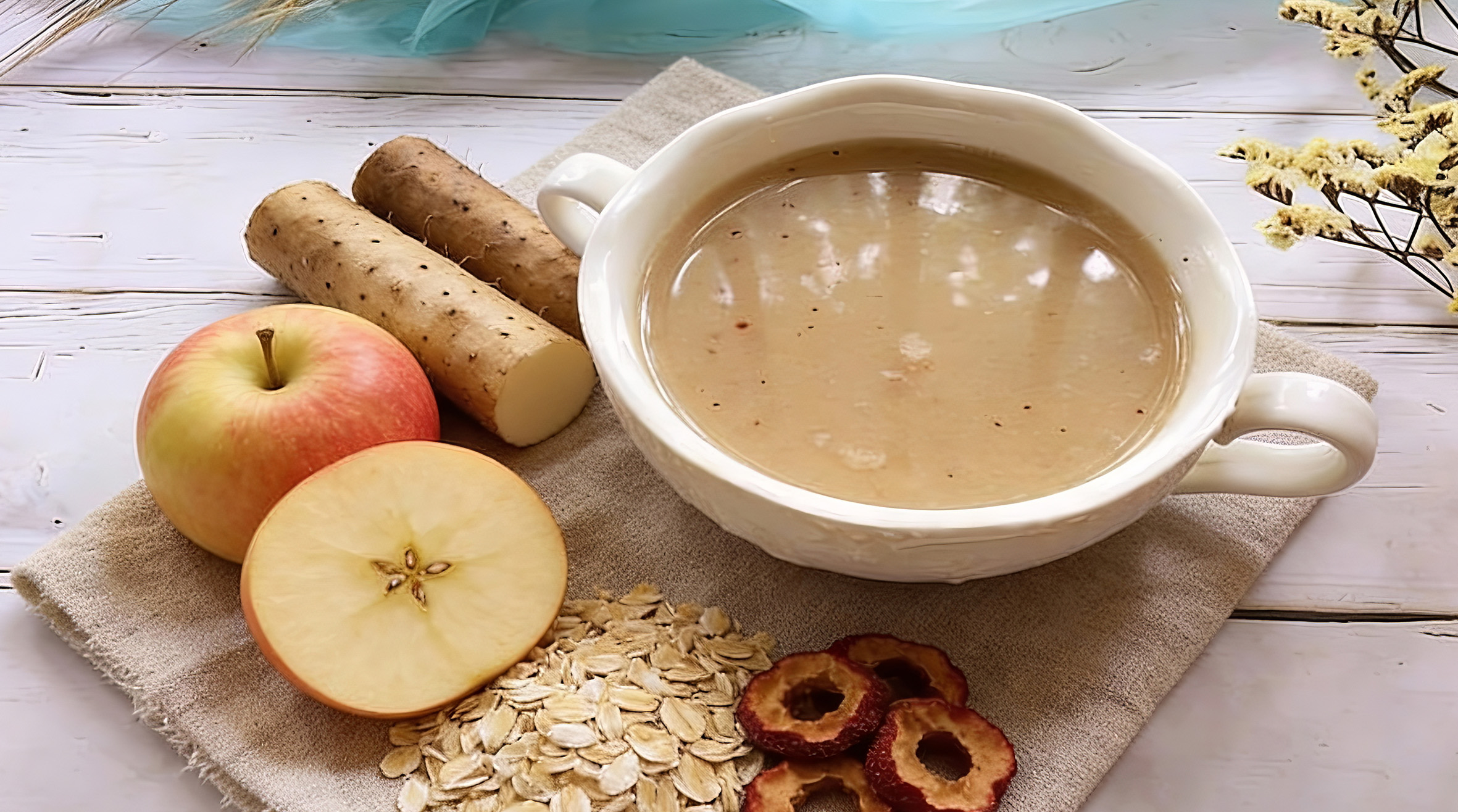
Chinese Yam Fluid-Generating Paste
This formula focuses on “increasing fluids and promoting bowel movement.” It combines the Spleen-tonifying and fluid-generating properties of Chinese yam with the pectin and fibre from apple and oat to moisten the intestines, enhance peristalsis, and support digestive function. The result is a comprehensive effect of fluid generation, appetite enhancement, and bowel regulation.
Core benefits: Tonifies the Spleen and generates fluids, moistens the intestines and promotes bowel movement, supports digestion and stimulates appetite.
Best suited for: Dry mouth and tongue, poor appetite, constipation or difficulty passing stools, post-illness dryness or constipation in elderly individuals.
Ingredients:
1. Chinese yam (fresh): 80 gm
- Nature & Meridians: Sweet, neutral; enters the Spleen, Lung, and Kidney meridians.
- Benefits: Strengthens the Spleen and tonifies Qi, generates fluids and benefits the Lung, providing power for gentle bowel movement.
2. Apple: 1pc(approx. 150 gm)
- Nature & Meridians: Sweet, slightly sour, cooling; enters the Lung, Stomach, and Large Intestine meridians.
- Benefits: Generates fluids and moistens the Lung, relieves irritability and improves appetite; rich in pectin, which helps regulate intestinal function in both directions.
3. Rolled oats / instant oats: 30 gm
- Nature & Meridians: Sweet, neutral; enters the Spleen, Stomach, and Liver meridians.
- Benefits: Strengthens the Spleen and nourishes the Heart; rich in soluble dietary fiber (β-glucan), which moistens the intestines, promotes bowel movement, and supports lipid regulation.
4. Dried hawthorn slices: 4–5 pcs
- Nature & Meridians: Sour, sweet, slightly warm; enters the Spleen, Stomach, and Liver meridians.
- Benefits: Aids digestion and resolves food stagnation, moves Qi and disperses stasis; its sour flavour helps generate fluids, stimulate appetite, and support digestion.
Preparation:
- Peel and cut the Chinese yam and apple into chunks (remove the apple core)
- Place all ingredients into the iTAZZO i-Processor.
- Add approximately 400 ml of water, blend at Speed 8 for 12 minutes.
Consumption Tips & Precautions
- Best Time: Mid-morning snack (9 am–11 am) or at breakfast. At this time, the Spleen meridian is active, digestion is strong, supporting nutrient absorption and stimulating intestinal motility.
- Frequency: Consume 3–4 times per week, or as needed when experiencing dryness or constipation.
- Important reminders:
- Individuals with excess stomach acid or active gastric ulcers should use caution or reduce the amount of hawthorn.
- Individuals with diabetes should monitor apple intake; green apples are recommended as a lower-sugar alternative.
《⼭药的专业解读与⻝疗应⽤》
⼀、 性味归经
- 性味:⽢,平
- 归经:脾、肺、肾经
【专业解读】
- 其“⽢”味能补、能和、能缓,是典型的补益之味。⼭药之“⽢”,主要作⽤于 脾、肺、肾三脏,以平补⽓阴,补⽽不滞,滋⽽不腻,为“平补三焦”之要药。
- 其“平”性是其最⼤特点,不寒不热,性质极为中和。这使得它既能补⽓,⼜能养阴,双向调节,适⽤于绝⼤多数体质,尤善在峻烈或偏性明显的⽅剂中起顾护中焦、缓和药性的作⽤。正如张锡纯在《医学衷中参⻄录》中所赞: “⼭药之性,能滋阴⼜能利湿,能滑润⼜能收涩,是以能补肺、补肾兼补脾胃。”
⼆、 传统中医理论核⼼
在中医理论中,⼭药的核⼼价值在于 “健脾固本”与“平补三焦”。
- 健脾固本:脾胃为后天之本,⽓⾎⽣化之源。⼭药⾊⽩⼊肺,味⽢⼊脾,汁液粘滑⼊肾,其补益之⼒⾸先且最强作⽤于脾脏。它能补脾益⽓,养脾阴,⽌脾泻,是治疗⼀切脾胃虚弱、⻝欲不振、久泻不⽌的⻝疗基⽯。固护好脾胃这个“本”,全身的⽓⾎和正⽓才有源泉。
- 平补三焦:
- 补肺⽓:通过补益脾⼟,滋⽣肺⾦(培⼟⽣⾦),间接强壮肺⽓,对于肺虚久咳、虚劳⽓喘有辅助之效。
- 益肾精:其粘滑之质,有固涩之能,能益肾⽓,固肾精,⽤于肾虚腰痛、遗精、带下、尿频。
- 敛阴液:对于⽓虚不固导致的⾃汗、盗汗,⼭药能通过益⽓养阴⽽达到⽌汗之效。
“脾为⽣痰之源,肺为贮痰之器”:⼭药健脾以绝“⽣痰之源”,是“治本”之策。对于脾虚导致的痰湿咳嗽,虽不直接化痰,但通过强化脾胃运化功能,能从根源上减少痰湿的⽣成,常与化痰药同⽤,标本兼顾。
三、 现代营养科学佐证
现代营养学分析表明,⼭药的传统功效与其独特的营养成分密不可分:
- 粘液蛋⽩与多糖:⼭药特有的黏滑汁液,主要成分为黏蛋⽩(Mucin)、薯蓣多糖(如⽢露聚糖)及薯蓣皂苷。这些物质能在消化道黏膜表⾯形成⼀层凝胶状保护层,起到物理屏障和润滑作⽤,有助于减轻胃酸和⻝物对胃壁的刺激,辅助修复胃黏膜。这为中医“健脾养胃、保护胃⽓”的理论提供了直接的物质基础。同时,这些活性多糖被证实具有调节免疫、抗氧化的⽣理功能。
- 淀粉与抗性淀粉:⼭药富含碳⽔化合物,以淀粉为主。其中⼀部分属于抗性淀粉,它不易被⼩肠消化吸收,能够完整地进⼊⼤肠。在结肠中,抗性淀粉可作为益⽣元,被肠道有益菌(如双歧杆菌、乳酸杆菌)发酵利⽤,促进其增殖,从⽽改善肠道菌群平衡、维护肠道屏障功能。这从微⽣态⻆度佐证了⼭药“益肠道、厚肠胃”的功效。
- 薯蓣皂苷(Diosgenin):这是⼭药中⼀类具有特征性的甾体皂苷元,是多种激素的前体物质。现代研究证实,薯蓣皂苷具有抗炎、抗氧化、调节脂质代谢和免疫调节等多种⽣物活性,有助于维持机体内环境的稳定,可能在其“补肾、抗衰⽼”的传统功效中扮演重要⻆⾊。
- 丰富的钾与微量元素:⼭药是钾元素的良好来源,有助于维持细胞渗透压和酸碱平衡,对⼼⾎管健康和神经肌⾁功能有积极作⽤。同时,它还含有锌、镁、铜、锰等多种微量元素,这些是体内多种酶和辅酶的重要组成部分,对于维持基础代谢、⽀持免疫功能⾄关重要。
- 【补充关键点】营养素密度与平稳供能:⼭药除上述成分外,还含有⼀定量的维⽣素C、维⽣素B族(如B1、B2)及膳⻝纤维。其淀粉消化吸收速度较慢,升糖指数(GI)属于中低⽔平,能提供持久平稳的能量释放,避免⾎糖剧烈波动,这符合中医“补⽽不骤,滋⽽不腻”的平补特性,特别适合作为脾胃虚弱者和糖尿病患者的调理⻝材。
四、 核⼼功效总结
- 补脾养胃:针对脾胃虚弱之⻝少便溏、体倦乏⼒。
- ⽣津益肺:针对肺虚久咳、虚劳⽓喘。
- 补肾涩精:针对肾虚遗精、带下清稀、尿频。
- 益⽓敛汗:针对⽓虚⾃汗、阴虚盗汗。
五、 ⻝疗古⽅新制
【健脾⽣津】
⼭药⽣津糊
此⽅侧重于“增液⾏⾈”,通过⼭药健脾⽣津、苹果与燕⻨富含的果胶及纤维来滋润肠道、促进蠕动,达到⽣津、开胃、通便的综合效果。
核⼼功效:健脾⽣津,润肠通便,消⻝开胃。
最佳体征:⼝⼲⾆燥,⻝欲不振,⼤便⼲结或排便不畅,病后⼝⼲、⽼年⼈肠燥便秘。
⻝材:
1. ⼭药(鲜):80 gm
- 性味归经:⽢,平;归脾、肺、肾经。
- 功效:健脾益⽓,⽣津益肺,为“润下”提供动⼒。
2. 苹果:1个(约150 gm)
- 性味归经:⽢、微酸,凉;归肺、胃、⼤肠经。
- 功效:⽣津润肺,除烦开胃,富含果胶能双向调节肠道。
3. ⽣/即⻝燕⻨⽚:30 gm
- 性味归经:⽢,平;归脾、胃、肝经。
- 功效:健脾养⼼,富含可溶性膳⻝纤维(β-葡聚糖),润肠通便,辅助降脂。
4. ⼭楂⼲:4-5 ⽚
- 性味归经:酸、⽢,微温;归脾、胃、肝经。
- 功效:消⻝化积,⾏⽓散瘀,其酸味能⽣津开胃,助消化。
做法:
- ⼭药去皮切块,苹果去⽪祛籽切块。
- 将所有材料放⼊智能养生机中
- 加⽔⾄400 ml左右,设定档速8,搅拌12分钟。
饮⽤宜忌与温馨提示
- ⻩⾦饮⽤时间:上午加餐(⺒时,上午9-11点)或早餐。此时脾经当令,消化功能强,有助于吸收营养并启动肠道蠕动。
- 饮⽤频率:每周3-4次,或于感觉⼲燥、便秘时饮⽤。
- 核⼼提醒:
- 胃酸过多、胃溃疡活动期者慎⽤或减少⼭楂⽤量。
- 糖尿病患者需注意苹果⽤量,可选⽤⻘苹果。