《 Professional Interpretation & Dietary Application of Celery 》
1. Nature,Tasteand Meridian
Nature & Taste: Sweet, Bitter, Cooling
Meridian Entered: Stomach, Liver, Heart meridians
Professional Interpretation
In Traditional Chinese Medicine (TCM), the sweet flavour has the functions of tonifying, harmonizing, and moderating. This allows celery to perform its clearing and descending actions without being overly harsh, giving it a balanced and harmonizing nature. The sweetness of celery is reflected in its high-water content, which helps nourish Stomach Yin (body fluids of the digestive system) and soothe Liver tension.
The bitter flavour is the key to celery’s core therapeutic effects. In TCM, bitterness has the functions of draining, drying, and firming. This is mainly expressed in celery’s ability to clear and descend Liver Fire and eliminate damp-heat. When Liver Fire is reduced, symptoms such as dizziness and red eyes may be relieved. When damp-heat is cleared, conditions such as jaundice and urinary discomfort (e.g., cloudy or difficult urination) may improve.
Its cooling nature complements its bitter properties, forming the foundation of its functions to clear heat, drain Fire, calm the Liver, and cool the Blood. As a result, celery is particularly effective in clearing excess heat from the Liver meridian and resolving dampness in the digestive system.
For individuals with a heat-dominant constitution or patterns of Liver Yang rising (a TCM pattern associated with stress, irritability, or hypertension), celery serves as an excellent medicinal food, offering both therapeutic and nutritional benefits.
2. CoreConceptsin Traditional Chinese Medicine (TCM)
In Traditional Chinese Medicine (TCM) health theory, the core value of celery lies in its ability to calm the Liver, clear heat, eliminate dampness and unblock the meridians.
Calming the Liver and Subduing Yang:
In TCM, the Liver belongs to Wood and prefers free flow and governs upward movement. When emotional stress is unresolved, or when Liver and Kidney Yin are deficient, Liver Yang may rise excessively to the head. This can manifest as dizziness, vertigo, facial flushing, red eyes, irritability, and anger.
Celery, entering the Liver meridian, has a cooling nature that helps clear Liver heat. At the same time, its light and dispersing quality allows it to gently guide excessive Yang downward, helping restore balance. This reflects TCM principles such as “treat heat with cold” and subdue what rises excessively”.
Eliminating Dampness and Unblocking the Meridians:
In TCM, the Spleen governs the transformation and transportation of fluids. When the Spleen and Stomach functions are impaired, dampness and damp-heat may accumulate internally. This can descend to the Bladder, affect the skin, or obstruct the meridians and vessels.
Celery’s sweet flavour harmonizes the middle (digestive system), its bitter nature dries dampness, and its cooling nature clears heat. Together, these properties help guide damp-heat out of the body through urination while unblocking meridians obstructed by dampness.
It may therefore be beneficial for conditions such as difficulty in urination, a heavy sensation in the limbs, or obstruction caused by phlegm and Blood stasis, providing supportive effects in clearing and promoting circulation.
“The Liver Opens into the Eyes”
In TCM, it is said that “the Liver opens into the eyes.” The nourishment of the eyes depends on sufficient Liver Blood.
- When Liver Fire flares upward, it may cause red, swollen, and painful eyes
- When Liver Yin or Blood is deficient, it may lead to dryness, blurred vision, or eye fatigue
Celery helps clear Liver heat and support Liver Yin, making it particularly useful for relieving eye redness and discomfort caused by excess Liver heat.
In modern lifestyles, prolonged screen use may deplete Liver Blood and generate internal heat. Moderate consumption of celery may therefore help support eye health and overall balance.
3. Supporting Evidence from Modern Nutritional Science
Modern nutritional research shows that the traditional benefits of celery are closely related to its unique nutritional composition.
Apigenin and Flavonoids:
Celery is rich in flavonoids, especially apigenin, which forms the key material basis behind its TCM function of “calming the Liver and clearing heat.” Modern pharmacological studies have shown that apigenin possesses anti-inflammatory, calming, and mild sedative effects. It also helps relax blood vessels and lower blood pressure.
This aligns closely with the TCM concept of “subduing Liver Yang to relieve headaches and dizziness.” By regulating the contraction and relaxation of vascular smooth muscles, apigenin helps stabilize elevated blood pressure and reduce sensations such as heaviness in the head or lightheadedness caused by blood pressure fluctuations.
Rich in Potassium:
Celery is an excellent source of potassium and it’s naturally low in sodium. Potassium helps promote the excretion of excess sodium and maintain the osmotic balance between intercellular and extracellular environments.
High sodium intake is one of the key contributors to fluid retention and elevated blood pressure. Through its mechanism of “promoting sodium excretion while retaining potassium,” celery helps reduce blood volume and supports blood pressure regulation. This aligns with the TCM concept of “eliminating dampness.” By increasing urination, celery helps remove excess fluids and metabolic waste from the body.
Volatile Oils and Dietary Fiber:
The characteristic aroma of celery comes from its volatile oils found in the stems and leaves. These compounds help stimulate gastric secretion, improve appetite, and promote intestinal movement, supporting the functions of strengthening digestion and relieving constipation. Its dietary fibre Further promotes bowel movement and acts as a prebiotic, helping regulate gut microbiota. This corresponds to the TCM concept of “harmonizing the Stomach and eliminating dampness”, by improving digestive function supporting fluid metabolism.
Phthalides:
Phthalides are characteristic compounds in celery that contribute to its distinctive aroma. Research suggests that phthalides may help relax the smooth muscles of arterial walls, thereby lowering blood pressure. They may also have a mild calming effect on the central nervous system, helping to reduce anxiety and improve sleep quality.
This aligns with celery’s traditional use in TCM to calm the mind and stabilize emotional states.
【Additional Key Point】Low-Calorie and Antioxidant Properties:
Celery contains over 95% water and it’s naturally low in calories, making it suitable for weight management and individuals with metabolic concerns such as high blood pressure, high cholesterol, or high blood sugar. It is also rich in vitamin C, vitamin E, and various flavonoids, forming a strong antioxidant network that helps neutralize free radicals, slow aging, and protect vascular endothelial health.
4. Summary of CoreEffects
Calming the Liver and Clearing Heat:
Helps address symptoms of Liver Yang rising, such as dizziness, vertigo, facial flushing, red eyes, irritability, and emotional restlessness.
Promoting Urination and Eliminating Damp-Heat:
Supports conditions related to damp-heat accumulation, including difficulty in urination, painful or scanty urination, and edema (fluid retention).
Cooling the Blood and Stopping Bleeding:
May help with mild bleeding conditions caused by Blood heat, such as nosebleeds or blood in the stool.
Relieving Constipation and Promoting Bowel Movement:
Supports relief of dryness-related constipation or constipation caused by Qi stagnation, helping to improve bowel regularity.
Unblocking the Meridians and Regulating Lipids:
Provides supportive benefits for conditions related to phlegm and Blood stasis obstructing the meridians, such as high cholesterol and a tendency toward atherosclerosis.
5. TraditionalDietary Recipes with Modern Adaptation
Indications: Lowering the 3 Highs 【Blood Pressure, Lipids, Blood Sugar】
Indications: 【Constipation】
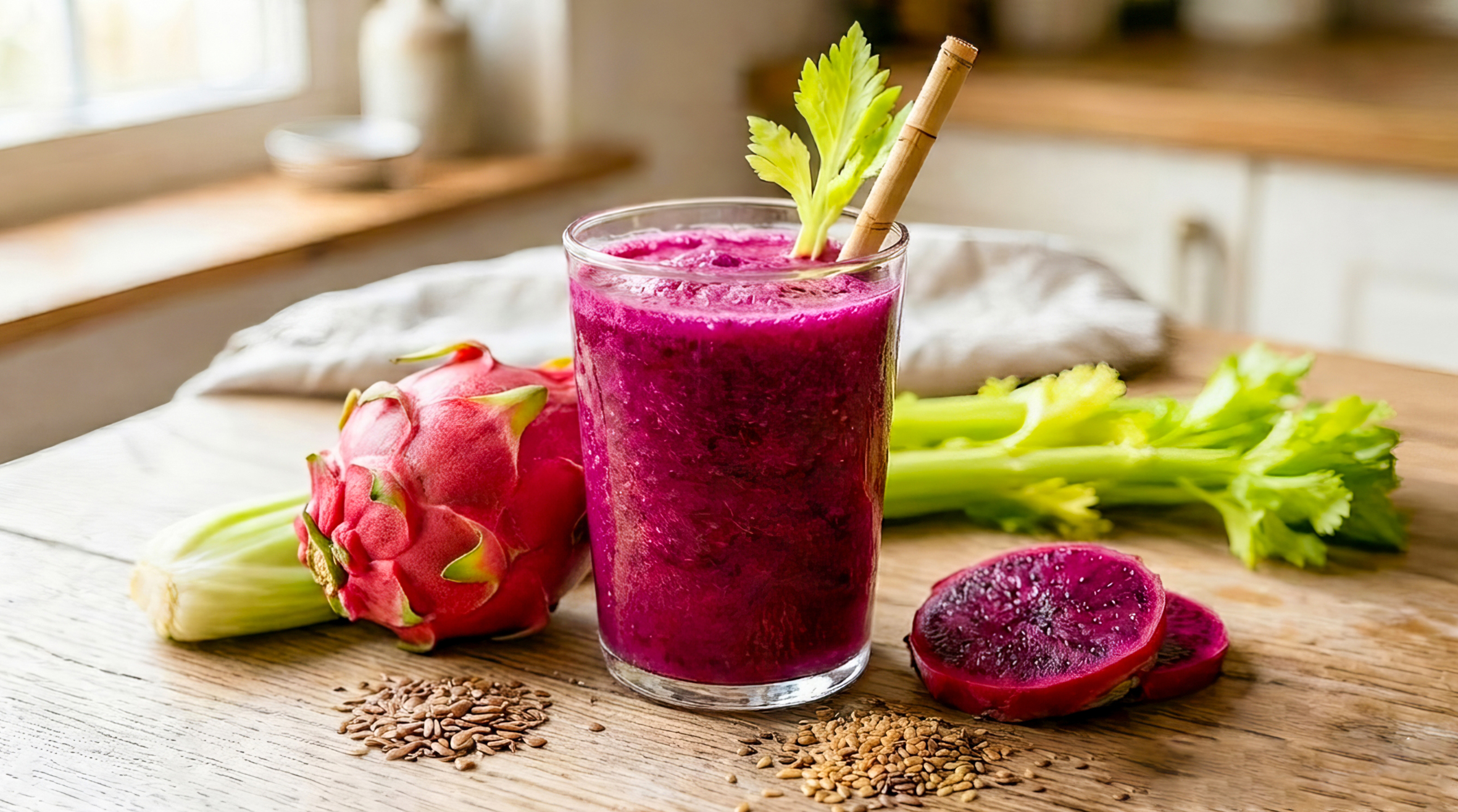
Celery – Bowel Relief Drink
This formula is designed for constipation caused by intestinal dryness and depletion of body fluids with heat accumulation. Common symptoms include hard, pellet-like stools, difficulty in passing stools, dry mouth and throat, and abdominal bloating.
It works through a gentle yet effective multi-action approach:
- Celery provides fibre to help “push” intestinal movement
- Dragon fruit (with its seeds and pectin) helps “lubricate” the intestinal walls
- Flaxseeds absorb water and expand, increasing stool-bulking effects
Together, these actions help relieve constipation in a natural and balanced way.
Core Effects:Clears heat, moistens the intestines, softens stools, and promotes bowel movement.
Best Suited For:Individuals experiencing dry, hard stools, difficulty in bowel movement, dry mouth and throat, abdominal discomfort, and reduced intestinal motility.
Ingredients (1–2 servings)
1. Celery – 1–2 stalks
- Nature & Meridian: sweet, bitter, cooling; enters Stomach, Liver, Heart meridians
- Benefits: Clears heat from the digestive system. Its coarse fibre helps promote bowel movement and facilitate the downward movement of waste.
2.Red Dragon Fruit – 1 wholefruit(about 200 g)
- Nature & Meridian: sweet, bland, cooling; enters Lung, Stomach, Large Intestine meridians
- Benefits: Clears heat, cools the Blood, and moistens the intestines to relieve constipation. Its seed-rich structure enhances its bowel-lubricating effect.
3. Flaxseeds – 10 gm
- Nature & Meridian: Sweet, Neutral; enters Liver, Stomach, Large Intestine meridians
- Benefits: Moistens dryness, lubricates the intestines, nourishes Blood, and helps relieve constipation.
4. Warm Filtered Water – 300–400 ml
- Benefits: Assists the ingredients in dispersing their effects and provides essential hydration for the intestines.
Preparation
- Wash the celery and cut into small sections. Peel the dragon fruit and cut into cubes.
- Place all ingredients into the iTAZZO i-Processor blend at Speed 6 for 2 minutes.
- Drink immediately for best results.
Consumption Tips & Precautions
- Best Time: Early morning on an empty stomach (5–7 AM), which corresponds to the Large Intestine meridian peak time in TCM. At this time, the intestines are most active, and consuming this drink can help naturally stimulate bowel movement.
- Frequency: Consume 3–4 times per week, or drink for 2 consecutive days when experiencing constipation.
- Important Reminders:
- Individuals with Spleen and Stomach deficiency-cold may replace dragon fruit with ripe banana to reduce the cooling nature.
- Mild gas or bloating after consumption is normal, as it indicates the dietary fiber is actively working in the intestines.
《 芹菜的专业解读与食疗应用 》
一、 性味归经
性味:甘、苦,凉
归经:胃、肝、心经
【专业解读】
其“甘”味能补、能和、能缓,使得芹菜在发挥其疏通、清降作用时,不会过于峻猛,具有调和之性。芹菜之甘,主要体现在其汁液丰富,能滋养胃阴,缓和肝急。
其“苦”味是其核心功效的关键。苦能泄、能燥、能坚,主要体现在泄降肝火、清利湿热。肝火得降,则头晕目赤可解;湿热得清,则黄疸、淋浊能愈。
其性“凉”,是其“苦”味之外的补充,共同构成其清热泻火、平肝凉血的功效基础。因此,芹菜尤善清肝经之热、利胃肠之湿,对于体质偏热、肝阳偏亢之人,是药食两用的佳品。
二、 传统中医理论核心
在中医理论中,芹菜的核心价值在于 “平肝清热”与 “利湿通络”。
平肝潜阳:肝属木,喜条达而恶抑郁。当情志不遂、或肝肾阴亏于下,易致肝阳上亢于头目,🎧现头晕目眩、面红目赤、烦躁易怒等症。芹菜入肝经,其性凉,能清肝热;其质轻,能升发清阳,使上亢之肝阳得以平降。这体现了中医“热者寒之”、“高者抑之”的治疗法则。
利湿通络:脾主运化水湿,若脾胃功能失调,湿热内生,既可下注膀胱,亦可浸淫肌肤,或阻滞脉道。芹菜味甘能和中,苦能燥湿,凉能清热,能够导湿热从小便而出,疏通被湿邪阻滞的经络。对于湿热内蕴导致的小便不利、肢体困重、甚至痰瘀阻络,均有辅助清利、疏通之效。
“肝开窍于目”:肝血上注于目,方能视物清晰。若肝火上炎,则目赤肿痛;若肝阴不足,则目涩昏花。芹菜能清肝热、养肝阴,对于肝火引起的目赤肿痛有直接的缓解作用。现代人长时间用眼,易致肝血暗耗,虚火上炎,适量食用芹菜,亦有裨益。
三、 现代营养科学佐证
现代营养学分析表明,芹菜的传统功效与其独特的营养成分密不可分:
芹菜素与黄酮类化合物:
芹菜中富含黄酮类物质,特别是芹菜素。这是其“平肝清热”功效的核心物质基础。现代药理研究证实,芹菜素具有明确的 抗炎、镇静、安神 作用,并能 舒张血管、降低血压,其作用机制与中医“平抑肝阳以治头痛、眩晕”的理论不谋而合。它通过调节血管平滑肌的收缩与舒张,帮助稳定过高的血压,缓解因血压波动引起的头重脚轻之感。
丰富的钾元素:
芹菜是高钾低钠食物的代表。钾离子能促进体内多余的钠离子排出,对于维持细胞内外的渗透压平衡至关重要。高钠摄入是导致水钠潴留、血压升高的重要原因之一。芹菜通过“排钠保钾”的机制,能有效降低血容量,从而辅助降压,这为中医“利湿”功效提供了科学解释——通过增加尿液排泄,带走多余的水分和代谢废物。
挥发油与膳食纤维:
芹菜特有的香气来源于其茎叶中的挥发油成分。这些成分能促进胃液分泌、增进食欲、刺激肠道蠕动,起到健脾开胃、宽肠通便的作用。其丰富的膳食纤维,不仅能促进排便,还能作为益生元,调节肠道菌群,维护肠道健康,这正对应了中医“和胃、利湿”中改善运化、促进水湿代谢的一环。
苯酞类化合物:
这是芹菜中另一类特征性成分,赋予了芹菜独特的清香气味。研究发现,苯酞类物质能够放松动脉壁的平滑肌,从而降低血压。同时,它可能对中枢神经系统有温和的镇静作用,有助于缓解焦虑和改善睡眠,这与芹菜辅助安定神志的传统应用相呼应。
【补充关键点】低热量与抗氧化:
芹菜含水量高达 95%以上,是典型的低热量食物,非常适合体重管理和“三高”人群食用。同时,它含有的维生素 C、维生素 E 及多种黄酮类物质,构成了强大的抗氧化网络,能够清除自由基,延缓衰老,保护血管内皮细胞健康。
四、 核心功效总结
平肝清热:针对肝阳上亢之头晕目眩、面红目赤、烦躁易怒
利湿通淋:针对湿热内蕴之小便不利、淋漓涩痛、水肿。
凉血止血:针对血热妄行引起的少量出血,如衄血、便血
宽肠通便:针对肠燥便秘或气滞便秘
通络调脂:针对痰瘀阻络之高血脂、动脉硬化倾向
五、 食疗古方新制
主治:【便秘】
芹菜~通便饮
此方针对“肠道失润、津亏热结”型便秘,这类人群常表现为:大便干结如羊粪、排便费力、口干舌燥、腹胀。通过芹菜丰富的粗纤维“推动”肠道,火龙果的种子和果胶“润滑”肠壁,亚麻籽的高纤遇水膨胀“扩充”粪便体积,三管齐下,温和而有效地解决便秘困扰。
核心功效:清热润肠,软化大便,促进肠道蠕动。
最佳体征:大便干结、排便费力、口干舌燥、腹胀不适、肠道蠕动功能减弱者。
食材(1-2 人份):
1. 芹菜:1-2 根
- 性味归经:甘、苦,凉;归胃、肝、心经。
- 功效:清胃肠热,其粗纤维能 “通腑气” ,推动糟粕下行。
2. 红心火龙果:1 个(约 200 克)
- 性味归经:甘、淡,凉;归肺、胃、大肠经。
- 功效:清热凉血,润肠通便。其多籽的特性使其润肠效果尤为突出。
3. 亚麻籽:10 gm
- 性味归经:甘,平;归肝、胃、大肠经。
- 功效:润燥滑肠,养血祛风。
4. 温过滤水:300-400 ml
- 功效:助药力行散,并为肠道补充必要的水分。
做法:
- 芹菜洗净切小段;火龙果去皮切块。
- 将所有材料放入 iTAZZO 智能养生机中,选择档速6号,搅拌2分钟。
- 立即饮用,效果更佳。
饮用宜忌与温馨提示
- 黄金饮用时间:清晨空腹(卯时,上午 5-7 点)。此时大肠经当令,肠道最为活跃,饮用此方可顺应天时,高效启动排便程序。
- 饮用频率:每周 3-4 次,或于便秘时连续饮用 2 天。
- 核心提醒:
- 脾胃虚寒者可将火龙果替换为熟的香蕉。
- 饮用后若出现轻微产气、腹胀,属正常现象,是膳食纤维在起作用的信号。