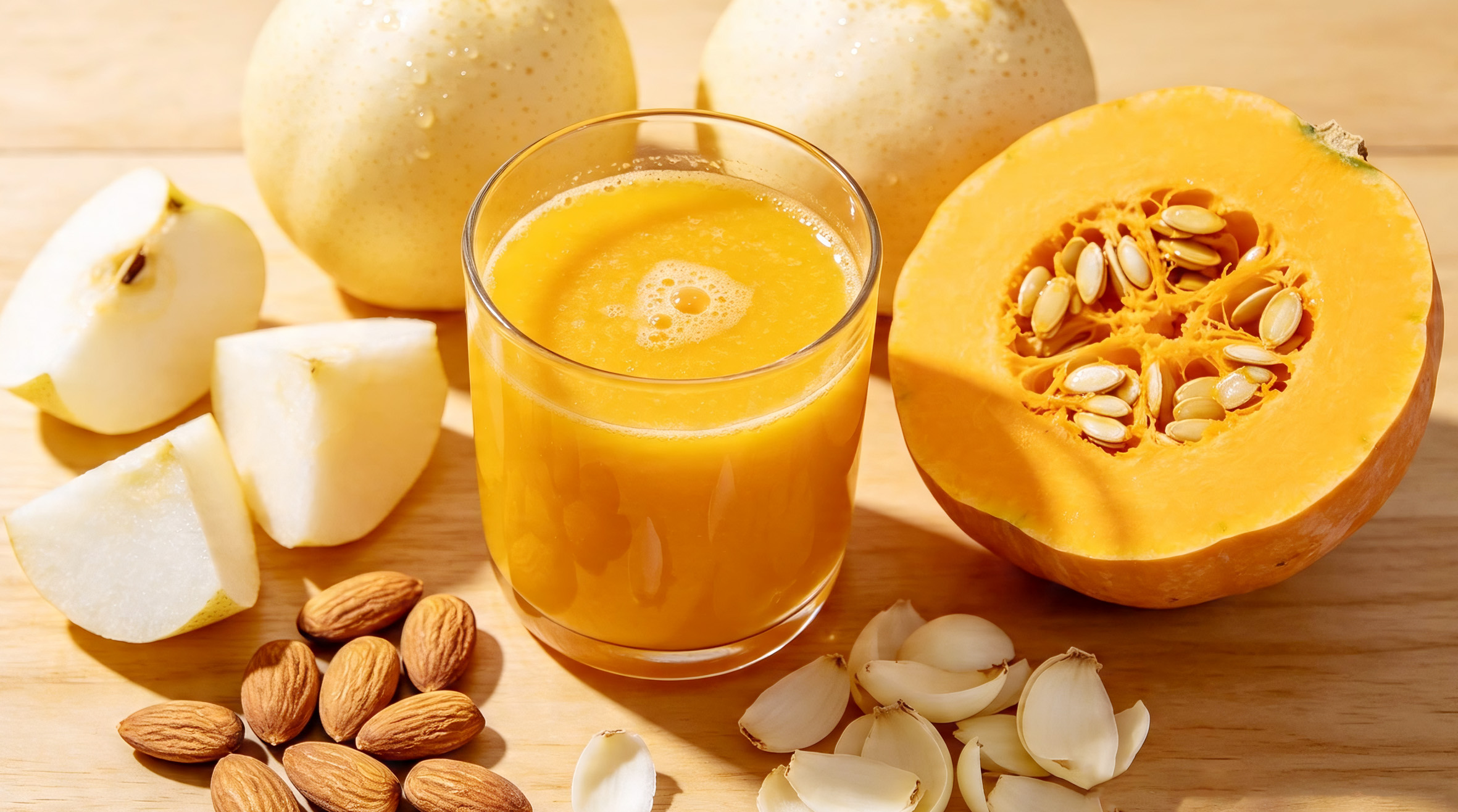
《 Professional Interpretation & Dietary Application of Pumpkin 》
1. Nature, Taste, and Meridians
Nature & Taste: Sweet, Warm
Meridian Entered: Spleen, Stomach, Lung meridians
Professional Interpretation
In Traditional Chinese Medicine (TCM), the sweet flavour has the functions of tonifying, harmonizing, and moderating. Pumpkin’s sweetness contributes to its ability to strengthen the Spleen and Stomach, nourish the body, and moisten the Lungs, while also supporting overall digestive balance.
The sweetness of pumpkin comes from its naturally occurring sugars, including glucose, sucrose, and fructose, as well as its rich content of vitamins and other nutrients. These components provide a gentle source of energy and help nourish the body’s internal systems.
Its warm nature gives pumpkin a comforting and nourishing quality, making it particularly suitable for individuals with Spleen and Stomach deficiency-cold or generally weak constitutions.
Pumpkin’s golden-yellow colour and rounded shape are traditionally associated with the Earth element in TCM. Since the Earth element corresponds to the Spleen and Stomach, pumpkin is believed to have a strong affinity for these digestive organs and is often regarded as a natural food for supporting digestive health.
Its warming nature helps dispel internal cold, making it especially beneficial for symptoms related to Middle Burner deficiency-cold, such as:
- Cold discomfort in the stomach or abdomen
- Poor appetite
- Weak digestion
- Reduced food intake
As recorded in the Compendium of Materia Medica (Ben Cao Gang Mu), pumpkin is said to “tonify the middle and replenish Qi.” Traditionally, it has long been used as a nourishing food to strengthen the digestive system and support recovery from weakness and fatigue.
2. Core Concepts in Traditional Chinese Medicine (TCM)
In Traditional Chinese Medicine (TCM), the core value of pumpkin lies in its ability to tonify the Middle Burner and replenish Qi, moisten the Lungs and resolve phlegm, and support detoxification and the elimination of intestinal parasites.
Tonifying the Middle Burner and Replenishing Qi
TCM regards the Spleen and Stomach as the foundation of postnatal life and the source of Qi and Blood production.
Pumpkin is yellow in colour and sweet in flavour, allowing it to enter the Spleen and Stomach meridians, where it effectively strengthens digestive Qi. The Spleen governs transformation and transportation, while the Stomach governs the reception and digestion of food. When these functions are strong, the body can continuously generate Qi and Blood to nourish the organs and limbs.
Pumpkin’s warm nature helps warm the Middle Burner and dispel internal cold. It is particularly beneficial for symptoms associated with Spleen and Stomach deficiency-cold, including:
- Poor appetite
- Indigestion
- Fatigue and lack of energy
- Loose stools
From a dietary therapy perspective, pumpkin acts like a gentle warming food that helps restore vitality to a weakened digestive system.
Moistening the Lungs and Resolving Phlegm
Pumpkin enters the Lung meridian. Its naturally sweet and moistening properties help nourish the Lungs and relieve dryness.
It is especially suitable for:
- Dry cough with little phlegm
- Dry throat and mouth due to seasonal dryness
- Chronic cough associated with deficiency of Lung and Spleen Qi
In TCM, the principle of “Cultivating Earth to Generate Metal”, explains that strengthening the Spleen (Earth) helps nourish the Lung (Metal). By supporting both the Spleen and the Lungs, pumpkin may assist in reducing phlegm formation and improving its transformation.
Its nature is warming without being drying, and moistening without being cloying, making it particularly suitable for children, elderly, and individuals with weak Lung and Spleen functions.
Detoxifying and Supporting the Elimination of Intestinal Parasites
Pumpkin has a long history of use in supporting intestinal health, particularly through its seeds.
Pumpkin seeds are considered sweet and neutral in nature and are believed to enter the Stomach and Large Intestine meridians. Traditionally, they have been used to support the elimination of intestinal parasites and assist the body’s natural detoxification processes.
Both the Compendium of Materia Medica (Ben Cao Gang Mu) and Chinese Materia Medica (Zhong Hua Ben Cao) record this traditional use. In folk practice, ground raw pumpkin seeds have often been consumed as a gentle dietary approach to support intestinal health, particularly in children and individuals with weak constitutions.
“The Spleen Generates Phlegm; the Lungs Store Phlegm”
Pumpkin addresses both aspects of this pathological process:
- Strengthening the Spleen reduces the formation of dampness and phlegm at the source
- Nourishing the Lungs help support the clearance of existing phlegm
This dual action of strengthening the Spleen first and then nourishing the Lungs allows pumpkin to help manage conditions such as chronic cough, excessive phlegm, and Spleen-Lung deficiency.
For individuals recovering from prolonged illness or experiencing weakness of both the Lung and Spleen, pumpkin provides gentle and sustained nourishment.
Its traditional role in detoxification and parasite support also complements its digestive benefits. In TCM, parasite accumulation is often associated with dampness and heat affecting the Spleen and Stomach.
Therefore, combining digestive support with parasite elimination reflects the TCM principle of addressing both the root cause and the symptoms simultaneously.
3. Supporting Evidence from Modern Nutritional Science
Modern nutritional research shows that the traditional health benefits of pumpkin are closely linked to its unique nutritional composition.
Beta-Carotene
Pumpkin, especially mature pumpkin, is rich in beta-carotene, the natural pigment responsible for its vibrant orange-yellow flesh.
In the human body, beta-carotene is converted into vitamin A, an essential nutrient for:
- Maintaining healthy vision, particularly night vision
- Protecting the skin and mucosal linings (respiratory tract and digestive epithelial linings)
This provides a molecular-level explanation for the TCM concept of “moistening and nourishing the Lungs.” In TCM, the Lungs govern the skin, body hair and open into the nose. Adequate vitamin A helps maintain the integrity of mucosal barriers, thereby enhancing the body’s defence against external pathogenic factors.
Pectin
Pumpkin contains abundant pectin, a type of soluble dietary fibre with significant physiological activity.
Pectin helps:
- Bind and remove heavy metals and harmful substances from the digestive tract
- Support the body’s natural detoxification and excretory processes
- Form a protective, gel-like layer over the gastric mucosa, reduce irritation from coarse or acidic foods (beneficial for individuals with gastric conditions)
These effects closely correspond to the TCM functions of “strengthening the Middle Burner” and “protecting the Stomach.” In addition, pectin helps slow the absorption of sugars, which may contribute to more stable blood glucose levels.
Cucurbitine
Pumpkin seeds contain cucurbitine, a unique amino acid compound, which can paralyse the neuromuscular system of tapeworms and roundworms, reducing their ability to attach to the intestinal wall and facilitating their natural elimination through bowel movements.
This effect has been confirmed by modern pharmacological studies, offering a molecular-level scientific foundation for the TCM theory of “detoxifying and expelling intestinal parasites.”
Pumpkin seeds’ anthelmintic action is mild and non-irritating to the gastrointestinal tract, making it particularly suitable for children and the elderly.
Cobalt
Pumpkin is considered one of the vegetables that contain relatively higher trace amounts of cobalt. Cobalt is an essential component of vitamin B12, which play a key role in:
- Red blood cell formation
- Synthesis of nucleic acids and proteins
- Cellular metabolism and energy production, including metabolism of carbohydrates and fats
This provides a modern nutritional explanation for the TCM concept of “tonifying the Middle Burner and replenishing Qi,” which is associated with improved energy recovery and enhanced physical vitality.
Polysaccharides and Amino Acids
Pumpkin polysaccharides have been shown to possess immunomodulatory properties, potentially enhancing both non-specific (innate) and humoral immune functions. Pumpkin also contains various amino acids, including citrulline and arginine, which play important roles in maintaining normal physiological functions and supporting tissue repair and regeneration. In addition, its rich potassium content helps regulate fluid and electrolyte balance, thereby supporting normal cardiovascular function as well as proper muscle contraction.
【Additional Key Point】A Gentle Source of Energy and Gastric Protector
Pumpkin combines easily digestible carbohydrates, pectin with gastric mucosa-protective properties, and immunomodulatory pumpkin polysaccharides, making it an ideal functional food for post-illness recovery, infant complementary feeding, and elderly nutritional support.
It provides a stable and gentle source of energy without placing excessive burden on the Spleen and Stomach, which aligns with the TCM principle of “tonifying the Middle Burner, replenishing Qi, strengthening the Spleen, and harmonizing the Stomach,” ultimately supporting gradual restoration of health.
Furthermore, the inclusion of pumpkin seed components enhances its traditional anthelmintic value, making it a natural dietary option for children malnutrition associated with parasitic infection and intestinal parasitic conditions.
4. Summary of CoreEffects
Tonifying the Middle Burner and Replenishing Qi
Suitable for individuals with Spleen and Stomach Qi deficiency, characterized by:
- Pale or sallow complexion
- Fatigue and low energy
- Poor appetite
- Bloating after meals
- Loose stools
Moistening the Lungs and Transforming Phlegm
Beneficial for conditions such as:
- Lung dryness with dry cough and scanty sputum
- Chronic cough with little phlegm
- Dry throat and mouth
- Cough with profuse phlegm due to Spleen deficiency generating phlegm
Strengthening the Spleen and Harmonizing the Stomach
May help relieve mild epigastric pain with preference for warmth and pressure, indigestion, and epigastric fullness or distension.
Detoxifying and Supporting the Expelling Intestinal Parasites
Traditionally used for:
- Intestinal parasites such as tapeworms and roundworms
- Children malnutrition associated with parasitic accumulation
Traditional Dietary Recipe with Modern Adaptation
Indications: 【Moistening the Lungs, Resolving Phlegm, Nourishing Yin, Relieving Cough, and Supporting Vitality】
Pumpkin – Lung-Nourishing & Phlegm-Relieving Drink
Best suited for Lung Dryness Cough Pattern, including:
- Dry cough with little phlegm
- Dry, itchy throat
- Thick, sticky phlegm that is difficult to expectorate
- Lung dryness caused by seasonal dryness (especially during autumn)
Also suitable for:
- Persistent cough due to Lung Yin deficiency
- Chronic cough associated with Lung and Spleen Qi deficiency (weak cough with thin, clear or white phlegm)
- Smokers seeking daily respiratory support
- Individuals who frequently use their voice, such as teachers and speakers
Ingredients (1–2 servings)
1. Fresh Pumpkin – 80 gm
- Nature & Meridian: Sweet, Warm; enters Spleen, Stomach, Lung meridians
- Benefits: Supports the TCM principle of “Cultivating Earth to Generate Metal” by strengthening the Spleen to nourish the Lungs, helping to moisten the respiratory system and relieve cough.
2. Snow Pear – 1pc
- Nature & Meridian: Sweet, slightly sour, Cooling; enters Lung and Stomach meridians
- Benefits: Promotes body fluids, relieves dryness, clears heat, transforms phlegm, and nourishes Lung Yin.
3. Sweet Almonds (Nan Xing Ren) – 12 gm
- Nature & Meridian: Sweet, Neutral; enters Lung and Large Intestine meridians
- Benefits: Moistens the Lungs, relieves cough, directs Lung Qi downward, helps resolve phlegm, and supports bowel regularity.
4. Lily Bulb (Bai He) – 20 gm
- Nature & Meridian: Sweet, slightly bitter, slightly cooling; enters Heart and Lung meridians
- Benefits: Nourishes Yin, moistens the Lungs, calms the mind, and works synergistically with pumpkin to support respiratory health.
5. Filtered Water – 300 ml
Preparation
- Wash, peel, and dice the pumpkin. Wash the snow pear, remove the core, and cut into small cubes. Rinse the lily bulb and sweet almonds.
- Place all ingredients into the iTAZZO i-Processor, blend at Speed 8 for approximately 10 minutes until smooth and creamy.
Note: If using organic pumpkin, the skin may be retained after thorough washing to preserve additional nutrients and dietary fibre.
Consumption Tips and Precautions
Best Time:
- After breakfast
- Or in the afternoon (3–5 PM)
According to TCM theory, the afternoon corresponds to the peak activity of the Bladder. Since the Lung and Bladder are interconnected through fluid metabolism, consuming this drink during this time may help support the Lung’s natural function of dispersing and descending Qi.
Frequency:
During episodes of cough:
- Once daily for 5–7 consecutive days
For daily lung maintenance (such as smokers or during dry autumn weather):
- 2–3 times per week
Important Reminders:
Especially Recommended For:
- Individuals with dry cough during autumn
- Smokers seeking respiratory support
- Teachers, speakers, singers, and others who frequently use their voice
- Individuals in the recovery phase of chronic bronchitis
This formula is intended as a supportive dietary therapy to nourish the Lungs, promote hydration, and support respiratory wellness. It should not replace medical treatment when symptoms are severe or persistent.
《 南瓜的专业解读与食疗应用 》
1. 性味归经
性味: 甘,温
归经: 脾、胃、肺经
【专业解读】
其“甘”味能补、能和、能缓,具有补益脾胃、润肺和中的作用。南瓜之“甘”,源于其丰富的天然糖分(葡萄糖、蔗糖、果糖)及多种维生素,能温和地为人体补充能量,滋养五脏六腑。 其“温”性使其性质温暖,尤其适合脾胃虚寒、体质偏弱之人。南瓜色黄,形圆,得土气最厚,故能直入脾胃,大补中气。黄色在五行中属土,对应脾胃,因此南瓜被视为“天然养胃菜”。其性温能散寒,对于中焦虚寒引起的脘腹冷痛、食少纳呆有很好的温补效果。正如《本草纲目》所载,南瓜能 “补中益气”,民间亦有用南瓜温养脾胃、调理虚弱的传统。
2. 传统中医理论核心
在中医养生理论中,南瓜的核心价值在于 “补中益气”、“润肺化痰” 与 “解毒杀虫”。
补中益气: 中医认为“脾胃为后天之本,气血生化之源”。南瓜色黄味甘,入脾、胃二经,最能补益脾胃之气。脾主运化,胃主受纳,脾胃功能强健,则气血生化有源,四肢百骸得以濡养。南瓜性 温,能温中散寒,对于因脾胃虚寒导致的食欲不振、消化不良、神疲乏力、大便溏薄等“中气不足” 之证,有极佳的食疗调养作用。它如同给虚弱的脾胃添了一把温和的火,使其重新恢复活力。
润肺化痰: 南瓜入肺经,其甘润之性能够滋养肺脏,缓解肺燥。对于秋燥引起的干咳少痰、咽干口燥,或慢性咳嗽属肺脾气虚者,南瓜能通过补益脾肺之气,达到“培土生金”(脾属土,肺属金,补脾可益肺)的效果,从而辅助化痰止咳。其温而不燥,润而不腻,特别适合老人、儿童等肺脾娇嫩者调养。
解毒杀虫: 南瓜在驱虫方面有独到之处,尤以其种子——南瓜籽为著。南瓜籽性味甘平,入胃、大肠经,能杀虫解毒,对绦虫、蛔虫等肠道寄生虫有麻痹和驱除作用。这一功效在《本草纲目》及《中华本草》中均有记载,民间亦常用生南瓜籽研粉调服以驱虫,其性平和,不伤正气,尤宜于小儿及体弱者。
“脾为生痰之源,肺为贮痰之器”:南瓜通过强健脾胃,从源头减少痰湿的生成,同时温润肺脏,帮助清除已停滞的痰浊。这种“先健脾,后润肺”的思路,使其能系统地改善因脾虚湿盛、肺气不宣引起的咳嗽、痰多等问题。对于久病体虚、肺脾两亏之人,南瓜能发挥其温和持久的补益之力,缓缓图之。而其“解毒杀虫”之功,又与“健脾和胃”相辅相成——虫积多因脾胃湿热而生,驱虫与健脾并举,方能标本兼治。
3. 现代营养科学佐证
现代营养学分析表明,南瓜的传统功效与其独特的营养成分密不可分:
- β-胡萝卜素: 南瓜(尤其是老南瓜)富含 β-胡萝卜素,这是其橙黄色果肉的颜色来源。β-胡萝卜素在人体内可转化为维生素 A,是维护视力健康(特别是夜视能力)、保护皮肤和黏膜完整性(如呼吸道、消化道黏膜)的关键营养素。这为中医“润肺”(肺主皮毛,开窍于鼻)的理论提供了分子层面的解释,充足的维生素 A 能增强黏膜屏障功能,抵御外邪。
- 果胶: 南瓜富含可溶性膳食纤维——果胶。果胶能吸附肠道内的重金属和有害物质,促进其排出体外,具有“解毒”作用。同时,它能在胃黏膜上形成一层保护膜,减轻粗糙食物对胃壁的刺激,非常适合胃病患者。这与中医“补中、护胃”的传统功效高度吻合。果胶还能延缓糖分吸收,有助于稳定血糖。
- 南瓜籽氨酸(Cucurbitine): 南瓜籽中特有的一种氨基酸,能麻痹绦虫、蛔虫的神经系统,使其失去吸附肠壁的能力,随粪便排出。这一作用在现代药理学研究中得到证实,为中医“解毒杀虫”理论提供了分子层面的科学依据。南瓜籽驱虫作用温和,不刺激肠道,特别适合儿童及老年人体质。
- 钴元素: 南瓜是已知蔬菜中钴含量较高的品种之一。钴是维生素 B12 的重要组成成分,能促进造血功能,参与核酸和蛋白质的合成。同时,钴还能激活人体新陈代谢,促进碳水化合物和脂肪的代谢。这为“补中益气”后精力恢复、体力增强提供了现代营养学依据。
- 多糖与氨基酸: 南瓜多糖具有显著的免疫调节作用,能增强机体非特异性免疫和体液免疫功能。南瓜还含有多种人体必需氨基酸,如瓜氨酸、精氨酸等,对维持身体正常生理功能、促进组织修复有积极作用。其丰富的钾元素有助于调节体液平衡,维护心脏和肌肉的正常功能。
【补充关键点】
温和的“能量补给站”与“胃部守护者”: 南瓜集易消化的碳水化合物、保护胃黏膜的果胶、增强免疫的南瓜多糖于一身,是一种理想的病后康复、儿童辅食及老年人保健食品。它能提供稳定而温和的能量,不增加脾胃负担,这与中医“补中益气、健脾和胃”后身体日渐康健的效果完全一致。而其南瓜籽成分更赋予了它独特的“驱虫”价值,成为小儿疳积、寄生虫感染的天然食疗选择。
4. 核心功效总结
- 补中益气: 针对面色萎黄、神疲乏力、食欲不振、食后腹胀、大便稀溏等脾胃气虚证。
- 润肺化痰: 针对肺燥干咳、久咳痰少、咽干口燥,以及脾虚生痰所致的咳嗽痰多。
- 健脾和胃: 针对胃痛隐隐、喜温喜按、消化不良、胃脘痞闷。
- 解毒杀虫: 针对绦虫、蛔虫等肠道寄生虫感染,以及小儿疳积(营养不良合并虫积)。
5. 食疗古方新制
主治: 润肺化痰,滋阴止咳,益气扶正
南瓜~润肺化痰饮
最佳体征: 肺燥咳嗽——干咳少痰、咽干喉痒、痰黏难咯;秋燥伤肺;久咳不愈属肺阴不足或肺脾气虚者(咳声低微、痰白清稀);吸烟者日常护肺调理。
食材(1-2 人份):
1. 南瓜(鲜):80 gm
- 性味归经:甘,温;归脾、胃、肺经。
- 功效:补土生金,润肺止咳,为“培土生金”之法。
2. 雪梨:1 个
- 性味归经:甘、微酸,凉;归肺、胃经。
- 功效:生津润燥,清热化痰,滋阴润肺。
3. 杏仁(南杏仁/甜杏仁):12 gm
- 性味归经:甘,平;归肺、大肠经。
- 功效:润肺止咳,降气化痰,润肠通便。
4. 百合:20 gm
- 性味归经:甘、微苦,微寒;归心、肺经。
- 功效:养阴润肺,清心安神,协同南瓜润肺止咳。
5. 过滤水:300 ml
做法:
- 南瓜洗净、去皮切块,雪梨洗净、去核切块,百合和南杏仁洗净备用。
- 将所有食材放入智能养生机中,设定档速8号,搅打约10分钟至细腻顺滑即可。
备注:若选用有机南瓜,建议洗净后连皮使用,可保留更多天然营养与膳食纤维。
饮用宜忌与温馨提示
- 黄金饮用时间: 早餐后或下午(申时,下午 3-5 点)。申时为膀胱经当令,肺与膀胱相别通,此时饮用可助肺气宣发肃降。
- 饮用频率: 咳嗽期间:每日 1 次,连续 5-7 天。日常护肺(如吸烟者、秋燥季节):每周 2-3次。
- 核心提醒: 【特别推荐】秋季干咳人群、吸烟者、教师等用嗓过度者、慢性支气管炎缓解期患者。